Data Silos
Critical business information is fragmented across ERP, CRM, accounting software, operational databases and spreadsheets.
DATA PLATFORM & BUSINESS INTELLIGENCE
Your business runs on data. But when information is scattered across multiple systems, spreadsheets and departments, turning that data into meaningful insights becomes a challenge.
Break down data silos, automate reporting and make better business decisions.
Agentic Workforce helps organisations design and implement modern data platforms that connect disparate business systems, consolidate information and deliver reliable business intelligence. From data integration and data warehouses to interactive dashboards and AI-powered analytics, we help you build the data foundation for a smarter, more connected business.

The challenge
Most organisations have no shortage of data. The challenge is bringing it together and making it useful.
Critical business information is fragmented across ERP, CRM, accounting software, operational databases and spreadsheets.
Employees spend valuable time extracting, consolidating and reconciling data instead of analysing it.
Different departments report different numbers for the same business metrics, undermining confidence in management reports.
Without a unified view of operations, identifying trends, inefficiencies and opportunities becomes difficult.
Information arrives too late, forcing management to make decisions based on outdated or incomplete data.
Fragmented and poorly governed data makes it difficult to deploy reliable AI analytics and intelligent agents.
Your data should be an asset that drives your business forward—not a problem that slows it down.
The solution
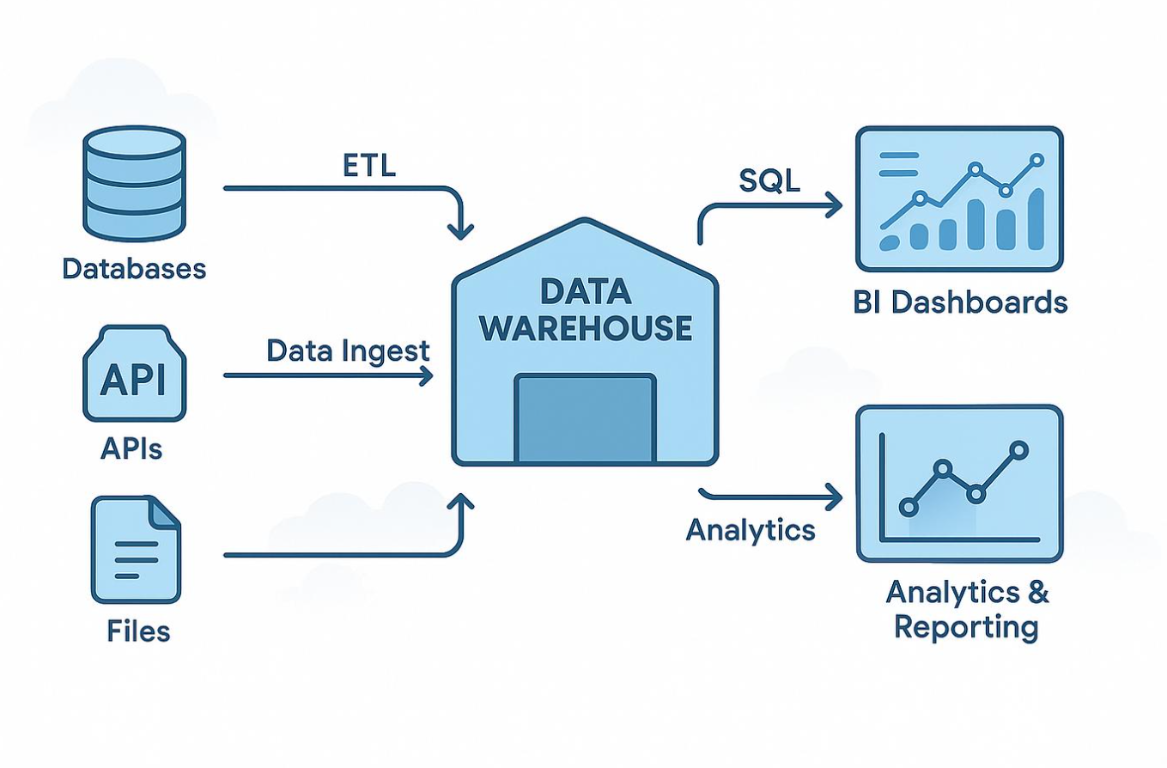
A modern enterprise data platform brings information from different business systems into a consistent, accessible and governed environment.
It provides the foundation for data warehousing, business intelligence, advanced analytics and AI-driven automation.
Connect
Integrate information from ERP, CRM, finance, HR, supply chain, production and other applications—whether hosted on-premises or in the cloud.
Organise
Clean, validate, standardise and structure your data using modern data warehouses, lakehouses and appropriate governance controls.
Analyse
Transform consolidated data into interactive dashboards, automated management reports, meaningful KPIs and actionable business insights.
Act
Extend your data platform with predictive analytics, natural-language queries and AI agents that can investigate information, generate recommendations and support business workflows.
From disconnected data to connected intelligence—and ultimately, intelligent action.
Our solutions & services
Whether you are starting your data journey or modernising an existing environment, we help you implement solutions that align with your business needs, technology landscape and budget.
Assess your existing systems, identify business priorities and design a scalable data architecture. Establish a practical roadmap covering technology, governance, security and future requirements.
Automate the extraction, transformation and movement of data across applications, databases, APIs and files. Replace repetitive manual consolidation with reliable, monitored data pipelines.
Design and implement centralised data repositories optimised for analytics and reporting. Choose between traditional data warehouses, modern cloud platforms and lakehouse architectures based on your requirements.
Create consistent business definitions, reusable analytical datasets and appropriate data access controls. Improve data quality, traceability and trust across the organisation.
Build interactive dashboards, management reports and self-service analytics solutions that provide timely visibility into business performance. Integrate with tools such as Microsoft Power BI and other BI platforms.
Prepare your data for advanced use cases, including forecasting, anomaly detection, natural-language analytics and agentic AI. Enable intelligent systems to access approved business data and support decision-making.
Business applications
A well-designed data platform enables better decisions across functions and industries.
Our technology approach
The right data platform depends on your business objectives—not the other way around.
We help you evaluate and implement solutions that fit your existing infrastructure, technical requirements, scalability needs and budget.
We consider cloud, on-premises and hybrid architectures, depending on your organisation's needs. Whether you need a straightforward reporting solution or a comprehensive enterprise data platform, our focus is on delivering the appropriate architecture without unnecessary complexity or cost.
Modern data technologies
Microsoft Fabric, Azure data services and Power BI
Cloud data warehousing and analytics
Unified data engineering, analytics and AI
BigQuery and related data services
AWS data storage, integration and analytics services
Databases, data pipelines and supporting analytics tools
Our approach
A successful data initiative starts with understanding what your business needs to achieve—not selecting technology.
Understand your business objectives, reporting challenges, existing applications and data landscape. Identify the highest-value opportunities.
Define the target architecture, prioritise data sources, select suitable technologies and establish a practical implementation roadmap.
Build data integrations, warehouses or lakehouses, analytical data models and reporting solutions. Validate data quality and accuracy against agreed business requirements.
Deliver dashboards and reporting capabilities, train users and establish the processes needed for effective adoption and ongoing operation.
Extend the platform to additional systems, departments and analytical use cases. Introduce advanced analytics and AI capabilities where they deliver value.
You do not need to transform everything at once. Begin with a priority business problem, demonstrate value and expand progressively.
From business intelligence to agentic AI
Traditional business intelligence helps organisations understand what has happened and what is happening. AI-powered analytics can go further by uncovering patterns, answering complex questions and supporting predictions.
Agentic AI introduces another possibility: intelligent systems that not only analyse information, but also help initiate and execute business workflows.
A Power BI dashboard shows overdue receivables increasing across several customers.
An AI assistant investigates the trend, identifies contributing invoices and payment patterns, and explains potential reasons for the increase.
An authorised AI agent prepares personalised payment reminders, initiates approved follow-up workflows and escalates exceptions to the responsible finance team.

All of this depends on access to reliable, relevant and appropriately governed data.
At Agentic Workforce, our broader expertise in AI agents and business process automation helps connect data initiatives with opportunities for intelligent automation.
Build the data foundation today. Unlock new possibilities with AI tomorrow.Frequently asked questions
An enterprise data platform is a collection of technologies and processes that enables organisations to integrate, store, manage, govern and analyse information from multiple sources. Depending on business requirements, it may include data warehouses, data lakes, lakehouses, data integration pipelines, governance capabilities and business intelligence tools.
A data warehouse is primarily designed to store structured, integrated information for reporting and analytics. A data platform is broader: it encompasses the technologies and processes used to collect, integrate, store, govern, transform and analyse data. A data warehouse can therefore be an important component of a wider enterprise data platform.
Your ERP manages operational business processes and transactions. A data platform complements it by combining information from multiple applications and enabling cross-functional analysis. For example, it can consolidate ERP financial information with CRM sales data, production records and external information to provide a more comprehensive business view.
Yes. A modern data platform can provide Power BI with consistent, reusable and governed datasets, reducing duplicated data preparation and improving reporting consistency. Existing Power BI reports may also be integrated or progressively enhanced, subject to compatibility and underlying data model requirements.
Yes. Data platforms do not necessarily require large enterprise budgets or complex architectures. An SME can start with a small number of business-critical data sources, a cost-conscious implementation and a focused set of dashboards. The architecture can evolve as requirements grow.
Not necessarily. In many cases, existing applications can remain in place while relevant data is integrated into a central analytical environment. The objective is to make better use of your current systems—not replace them unnecessarily.
Yes. Depending on your technology choices and requirements, cloud, on-premises and hybrid architectures can be considered. Factors include security, data residency, compliance, infrastructure and operating costs.
The duration depends on the number of data sources, integration complexity, data quality, infrastructure and reporting requirements. A phased implementation is often preferable, starting with a well-defined use case before expanding to additional systems and capabilities.
Let's unlock the value of your data
Whether you need a data warehouse, consolidated management reporting, interactive BI dashboards or a foundation for AI, we can help you identify the right starting point.
Tell us about your existing systems, reporting challenges and business objectives. Let's explore a practical solution that delivers value today and supports your business tomorrow.