Key Takeaways
- For employees, AI raises the ceiling on what they can do, but also raises the bar for judgment.
- For business leaders, AI adoption is now an operating model challenge, not just a technology rollout.
- For organizations, the real advantage comes from capturing learnings and turning them into repeatable ways of working.
Microsoft’s 2026 Work Trend Index makes one thing clear:
AI is not only changing tasks.
It is changing the relationship between people, work, and the organization.
For employees, AI is expanding capability. 58% of AI users say they are producing work they could not have done a year ago. Among the most advanced AI users, that rises to 80%.
But this does not make human skills less important.
It makes quality control, critical thinking, intent-setting, and accountability more important. AI can help generate the work, but humans still need to own the thinking.
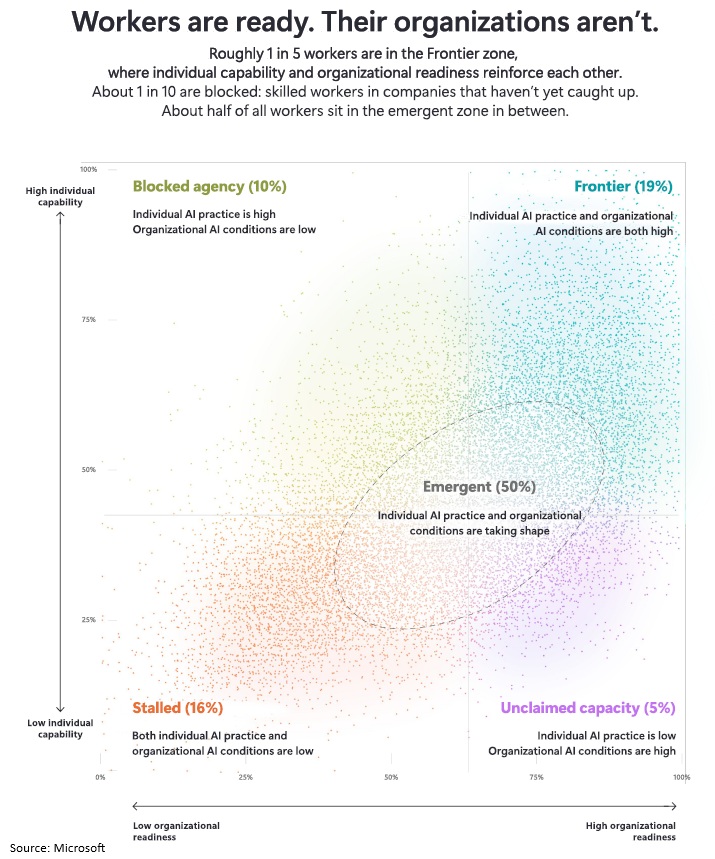
For business leaders, the message is more uncomfortable.
Most organizations are not yet built to capture the value their people can now create with AI. Only 26% of AI users say leadership is clearly and consistently aligned on AI.
That is a management problem, not a model problem.
Leaders need to decide what humans do, what agents do, how work is reviewed, and how reinvention is rewarded.
For organizations, the opportunity is to become a learning system.
The firms pulling ahead are not just adopting AI tools. They are capturing what works, documenting agent workflows, improving handoffs, and building institutional knowledge and proprietary data that compounds.
The strategic implication is simple:
AI transformation is no longer about helping individuals work faster.
It is about redesigning the system so employees, leaders, and agents can create better outcomes together.
What do you think will be the hardest part: changing employee habits, leadership behavior, or organizational systems?
#AI #Automation #FutureOfWork #AgenticAI #DigitalTransformation