
Key Takeaways
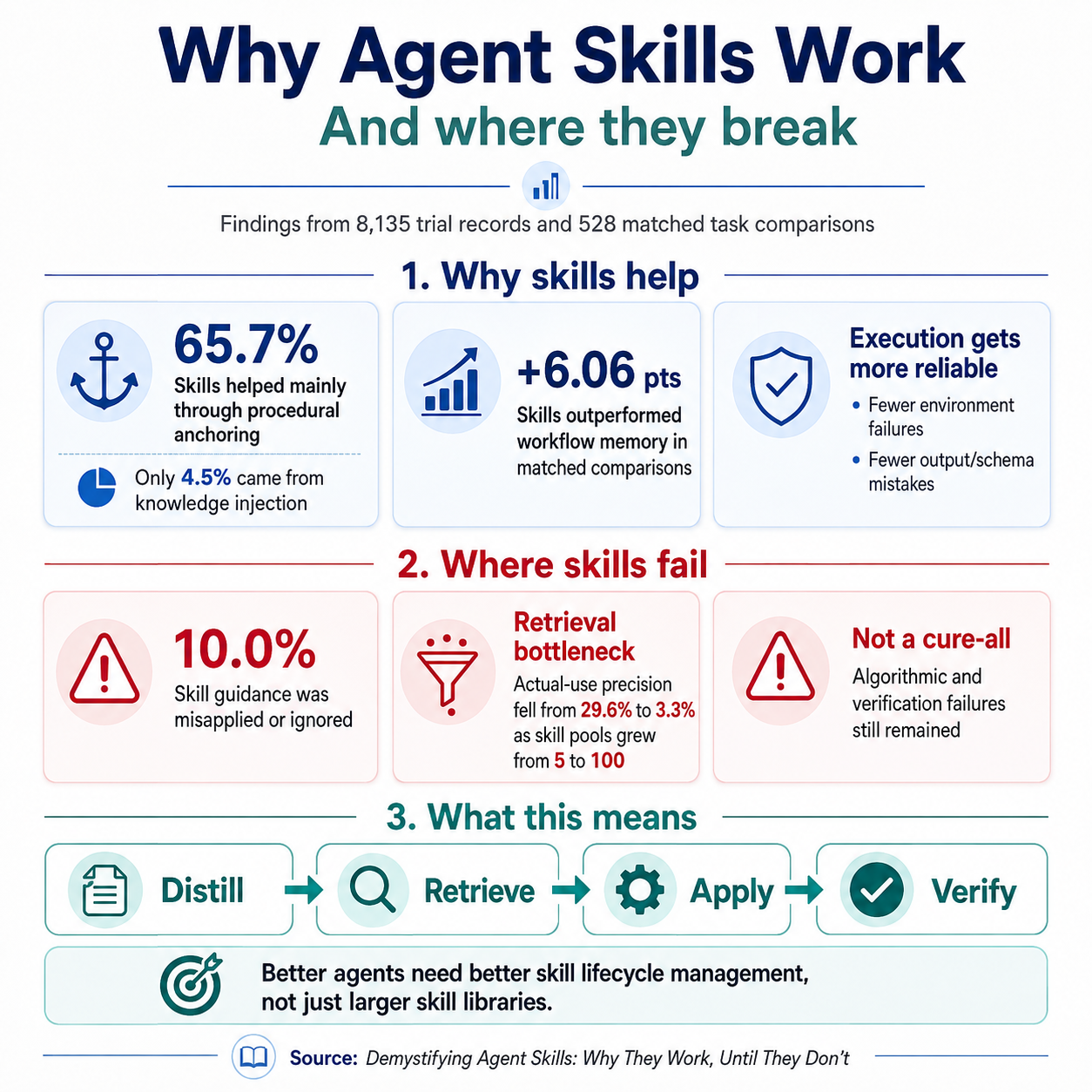
- 65.7% of skill benefits came from procedural anchoring, versus just 4.5% from knowledge injection.
- Skills outperformed direct workflow memory by 6 percentage points in matched comparisons.
- As skill pools grew from 5 to 100, execution-time precision fell from 29.6% to 3.3%.
Here is an important lesson here for anyone building AI agents.
More memory does not automatically create a better agent.
The research paper ‘Demystifying Agent Skills: Why They Work—Until They Don’t’ found that skills are most useful when they turn messy past experience into a clean standard operating procedure: what steps to take, what tools to use, what to verify and what mistakes to avoid.
Skills are particularly effective at reducing operational execution failures. Environment/infrastructure failures fell from 5.3% without skills to 0.2% with skills, output/schema errors from 7.4% to 3.2%, and background-service lifecycle failures from 2.7% to 0.8%.
The distinction between memory and skills matters.
Raw workflow memories can preserve failed attempts, debugging detours and unnecessary detail. Skills compress that experience into something more actionable.
But abstraction creates another problem.
The agent still needs to decide whether a skill applies, which parts matter and when the procedure needs to be adapted. Skill guidance was misapplied or ignored in 10% of skill-assisted cases. Indeed, skill retrieval becomes a major scalability bottleneck as skill libraries grow.
This is why we think the harder problem in agentic AI may eventually shift from creating skills to managing the skill lifecycle.
Generate the right procedure. Retrieve the right one. Apply it in the right context. Verify the result.
Simply building a bigger skill library is not enough.
The key design implication for agent builders is to treat agent skills as adaptive procedural playbooks rather than static instructions. The biggest opportunities lie in improving skill abstraction, applicability conditions, retrieval, runtime adaptation and verification.
How are you thinking about skill management as your AI agents become more complex?
#AgenticAI #AIAgents #EnterpriseAI #IntelligentAutomation #AIAutomation #AgentSkills #AgentSkillsForEnterpriseAI