Key Takeaways
- Start with measurable business outcomes rather than counting AI tools or use cases.
- Simplify end-to-end workflows and establish shared data before introducing AI agents.
- Preserve competitive advantage by codifying expertise, improving AI performance, and protecting enterprise intelligence.
Microsoft's Frontier Playbook, shaped by more than 100 internal AI transformation case studies, highlights a practical distinction: deploying AI tools is not the same as transforming a business.
AI delivers more meaningful value when organizations rethink how work gets done, connect new capabilities to business outcomes, and help people adopt different ways of working.
Redesign the workflow before deploying agents
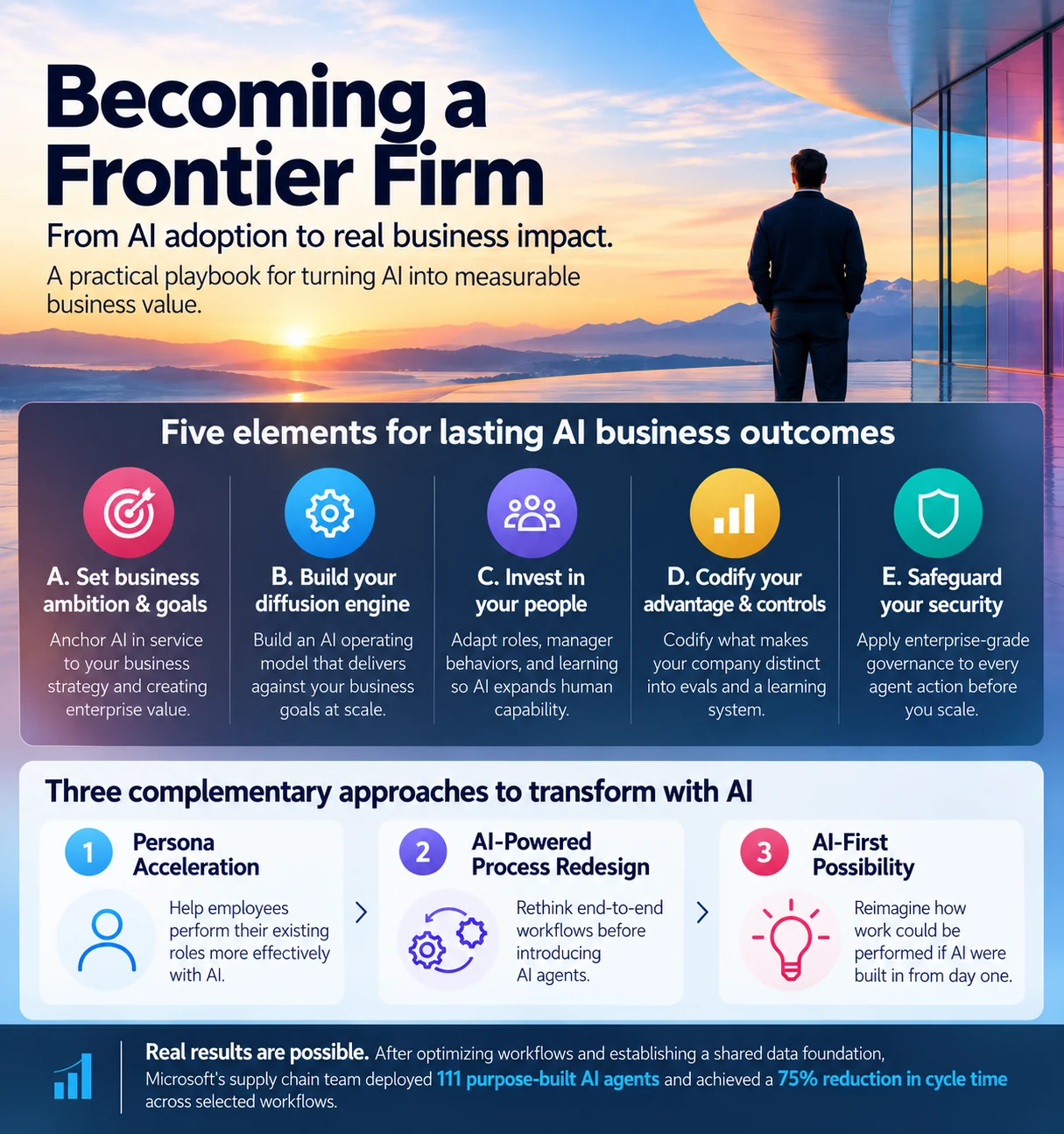
Microsoft's supply chain team first simplified its processes and established a shared data foundation. Only then did it deploy 111 purpose-built AI agents.
Across selected workflows, the team achieved a 75% reduction in cycle time. The key lesson is not the number of agents. It is the sequence: simplify, establish reliable shared data, and then automate.
Inserting AI into a fragmented process can speed up individual tasks without fixing the end-to-end workflow. The more important question is whether that workflow should be redesigned in the first place.
Three complementary approaches to AI transformation
- Persona Acceleration: Help employees perform their existing roles more effectively by applying AI within their everyday work.
- AI-Powered Process Redesign: Rethink end-to-end processes before introducing agents, rather than preserving inefficiencies.
- AI-First Possibility: Reimagine how work could be performed if AI were part of the operating model from day one.
These approaches address different opportunities. Some work benefits from targeted support for employees. Other work calls for complete process redesign or a fresh starting point.
Look beyond efficiency gains
Efficiency is valuable, but it is not the only opportunity. AI can also enable capabilities that were previously difficult to deliver at the same speed or scale, including predictive intelligence, faster experimentation, and better decision-making.
Longer-term differentiation also depends on codifying proprietary expertise, continually improving AI performance, and protecting the enterprise intelligence that makes an organization distinct.
The strategic takeaway: The greatest transformation opportunity is not simply automating existing work. It is redesigning work so that people, processes, and AI agents can deliver better business outcomes together.
What is the biggest obstacle to enterprise AI transformation in your organization: technology, data, processes, or people?
Source / Further reading: Becoming a Frontier Firm: Our Frontier Playbook - Microsoft