
Key Takeaways
- Nearly 9 in 10 organizations already use AI in at least one business function, so adoption alone is no longer a differentiator.
- Common AI tools and models are increasingly accessible, making the model itself a weak source of lasting competitive advantage.
- More durable moats can come from privileged data, embedded workflows, shared AI infrastructure, governance, and AI-enhanced assets or networks.
- Leaders should measure whether AI strengthens existing advantages and creates hard-to-replicate operating capabilities, not just short-term productivity gains.
AI adoption is no longer the differentiator. The harder question is what a company builds around AI.
Nearly 9 in 10 organizations now use AI in at least one business function. As access to capable models broadens, simply deploying AI becomes table stakes rather than a defensible advantage.
The model is not the moat
When companies can access similar large language models, the model itself becomes easier to copy. Sustainable advantage depends on the system around it and on how effectively AI strengthens what the business already does well.
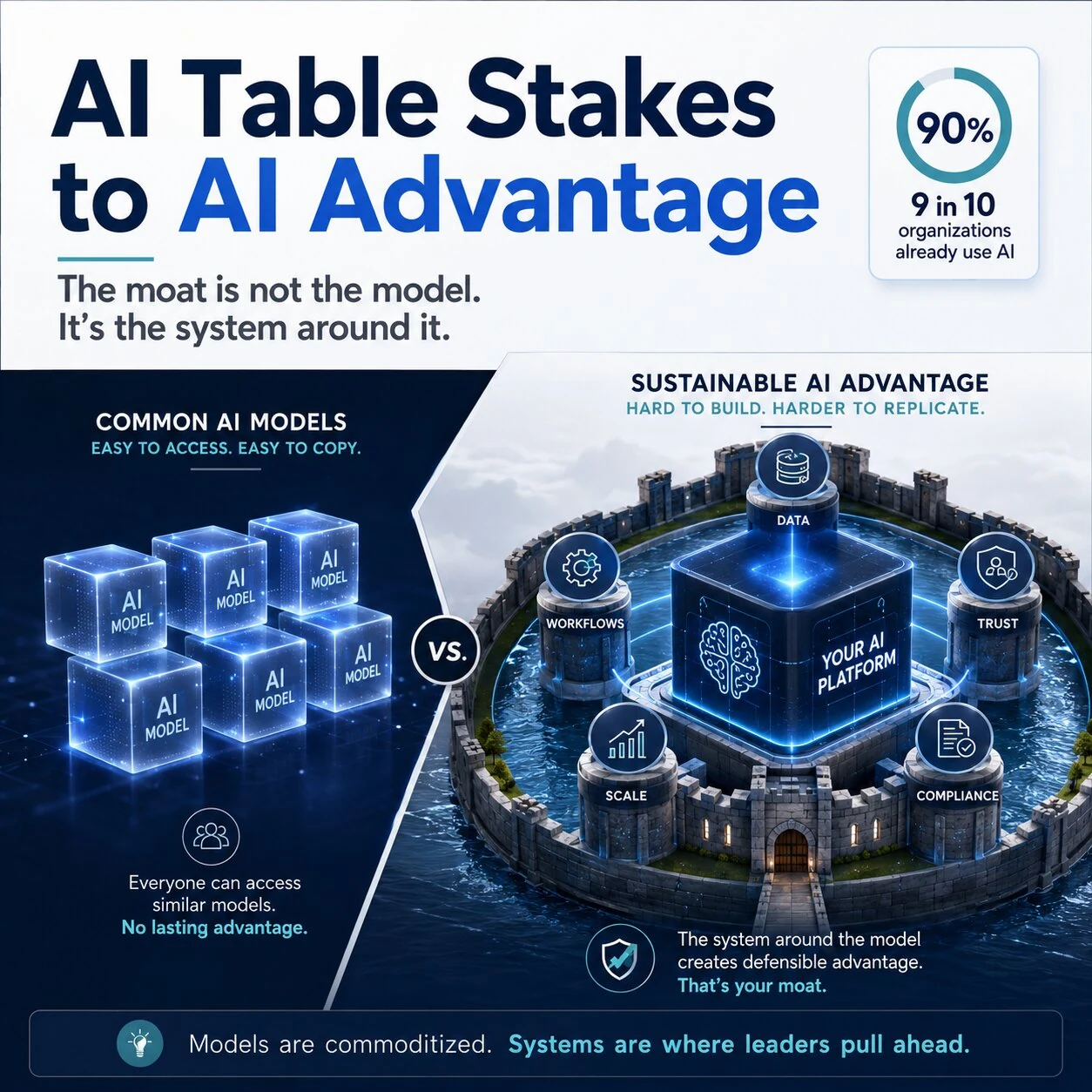
Where durable AI advantage can come from
The opportunity is to turn widely available AI capabilities into assets and operating systems that competitors cannot easily reproduce. That can include:
- Privileged data that improves decisions and creates better feedback loops.
- AI embedded deeply into core workflows rather than isolated tools or experiments.
- Shared AI infrastructure that lowers transaction costs and enables capabilities to scale.
- Trusted governance that supports adoption in regulated or high-accountability environments.
- Physical assets, distribution networks or operational systems whose value increases when AI is integrated into them.
Why many AI programs still fall short
Many organizations still approach AI primarily as a technology rollout: add copilots, launch proofs of concept, automate tasks and measure productivity. Those efforts can matter, but they do not by themselves create a lasting moat.
The more strategic question is: Where can AI make our existing advantage stronger, faster, cheaper and harder to replicate?
From isolated use cases to operating advantage
For automation and business leaders, that means moving beyond individual use cases and doing the harder work of building reusable AI platforms, capturing better data, redesigning workflows end to end, embedding governance early, and measuring whether AI is creating lasting business advantage rather than only short-term efficiency.
The next wave of AI winners may not be the companies with the most experiments. They may be the ones that turn common models into uncommon operating advantages.
Discussion question: What is most likely to become the strongest AI moat over the next 12 months: economies of scale, privileged data, embedded AI, network effects, business model innovation, constrained assets, speed, compliance or trust?
Source / Further reading: From AI table stakes to AI advantage: Building competitive moats — McKinsey & Company