Key Takeaways
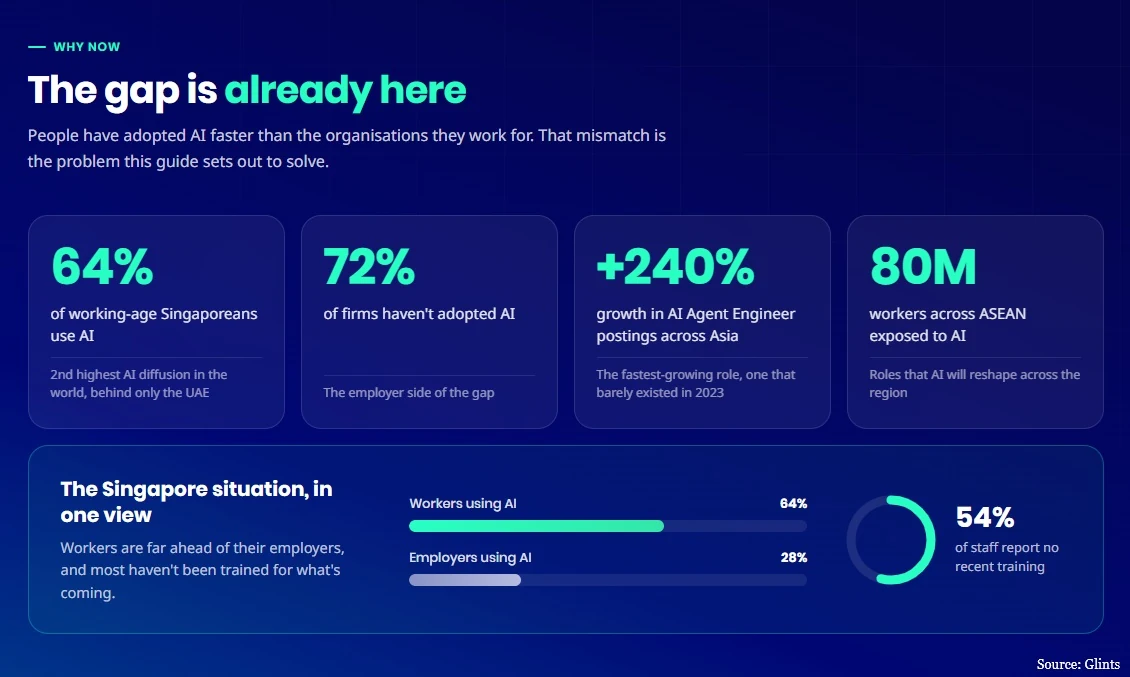
- In Singapore, 64% of working-age adults use AI, but 72% of firms have not adopted it.
- AI skills extend beyond IT: 51% of job postings requiring AI skills are outside IT.
- While 47% of Singapore workers recognise the need to upskill, more than half have received no recent training or mentorship.
- AI Agent Engineer job postings have grown by 240%, reflecting demand for emerging capabilities.
- An AI-ready workforce requires both targeted hiring and redesigned workflows that make effective use of existing employees and AI agents.
People are adopting AI faster than the organisations they work for. In Singapore, 64% of working-age adults use AI, while 72% of firms have not adopted it.
The 2026 AI-Ready Workforce Guide by Glints TalentHub and Gutsy highlights a gap that goes beyond technology. It affects how businesses recruit, train and organise work.
AI skills are spreading beyond IT
AI literacy is becoming relevant across business functions. Some 51% of job postings that require AI skills are outside IT, while AI Agent Engineer postings have grown by 240%.
Yet readiness is uneven. Although 47% of Singapore workers recognise the need to upskill, more than half have received no recent training or mentorship.
Hiring alone will not close the gap
Recruiting AI specialists is important, but it is only one part of becoming AI-ready. Existing employees also need access to useful AI tools, opportunities to develop their skills and workflows designed around what AI can actually do.
This is not simply about teaching everyone to write better prompts. It means rethinking how work gets done and identifying where people and AI can complement each other.
Designing work around people and AI agents
Agentic AI adds another dimension. Rather than only assisting with isolated tasks, AI agents can coordinate workflows, connect business systems and execute routine activities, while humans retain control over important decisions.
That creates an opportunity to improve workforce productivity without necessarily increasing headcount. Leaders need to build the capabilities they lack while redesigning existing operations to make effective use of AI.
The future of work is not just about having more AI-skilled employees. It is about building organisations where people and AI work effectively together.
What is the bigger challenge in your organisation today: finding AI-ready talent or transforming how existing employees work?
Source / Further reading: The AI-Ready Workforce: 2026 Talent & Hiring Guide - Glints TalentHub and Gutsy