
Key Takeaways
- Competitive pressure can make individually rational AI automation decisions collectively harmful.
- More capable AI and stronger competition can increase the incentive to over-automate.
- Sustainable benefits depend in part on whether displaced workers can regain their purchasing power.
AI-driven layoffs raise a question that goes beyond any one company’s cost savings: what happens when many businesses automate jobs at the same time?
In February 2026, Block announced layoffs affecting approximately 4,000 employees, nearly half its workforce, citing AI-driven changes. That makes the question more than an abstract discussion about the future of work.
When individual efficiency creates a collective risk
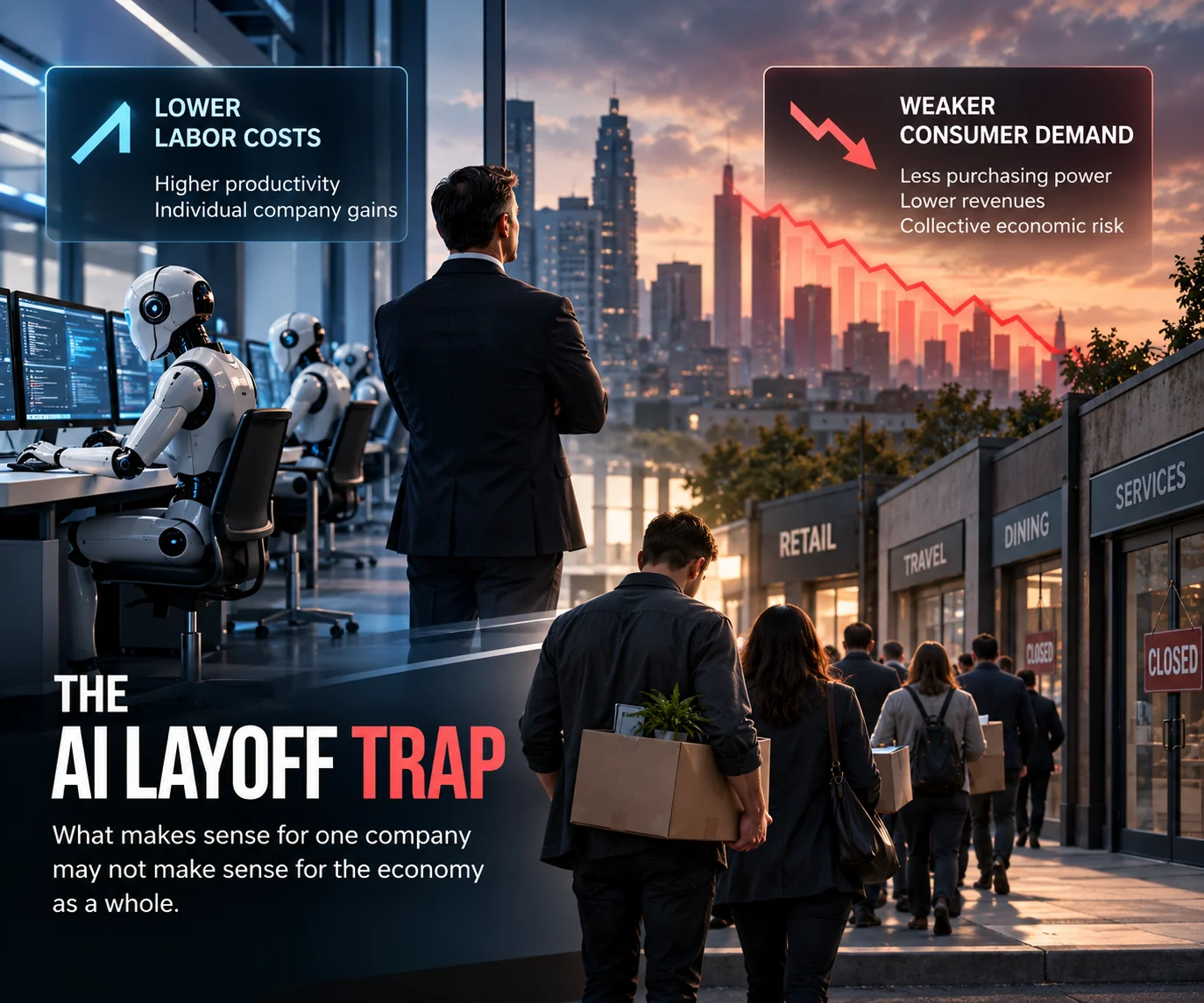
At the company level, the business case for AI automation can be compelling. A firm captures the savings from replacing labor, but bears only a fraction of any decline in consumer spending caused by displaced workers losing income.
Other businesses absorb much of that reduction in spending. If many firms make the same decision, the combined effect can be weaker demand, lower revenues and ultimately lower aggregate profits.
Why better AI may not solve the problem
The economic model in The AI Layoff Trap explores how competitive pressure can push firms to automate beyond what would be collectively beneficial. More capable AI can intensify that pressure, rather than remove it.
This is a theoretical risk, not evidence that an economy-wide crisis is already unfolding. Its severity depends on the pace of displacement relative to the creation of new work.
The question for AI transformation
A critical factor is whether displaced workers can move into new roles with comparable or higher income. If they can, the loss of purchasing power can be reduced.
Cost reduction is not the same as sustainable value creation. AI transformation should be evaluated not only by the work it eliminates, but also by the economic value and opportunities it helps create.
Should businesses factor the broader economic consequences into their AI automation strategies, or is that primarily a responsibility for policymakers?
Source / Further reading: The AI Layoff Trap - arXiv