
Key Takeaways
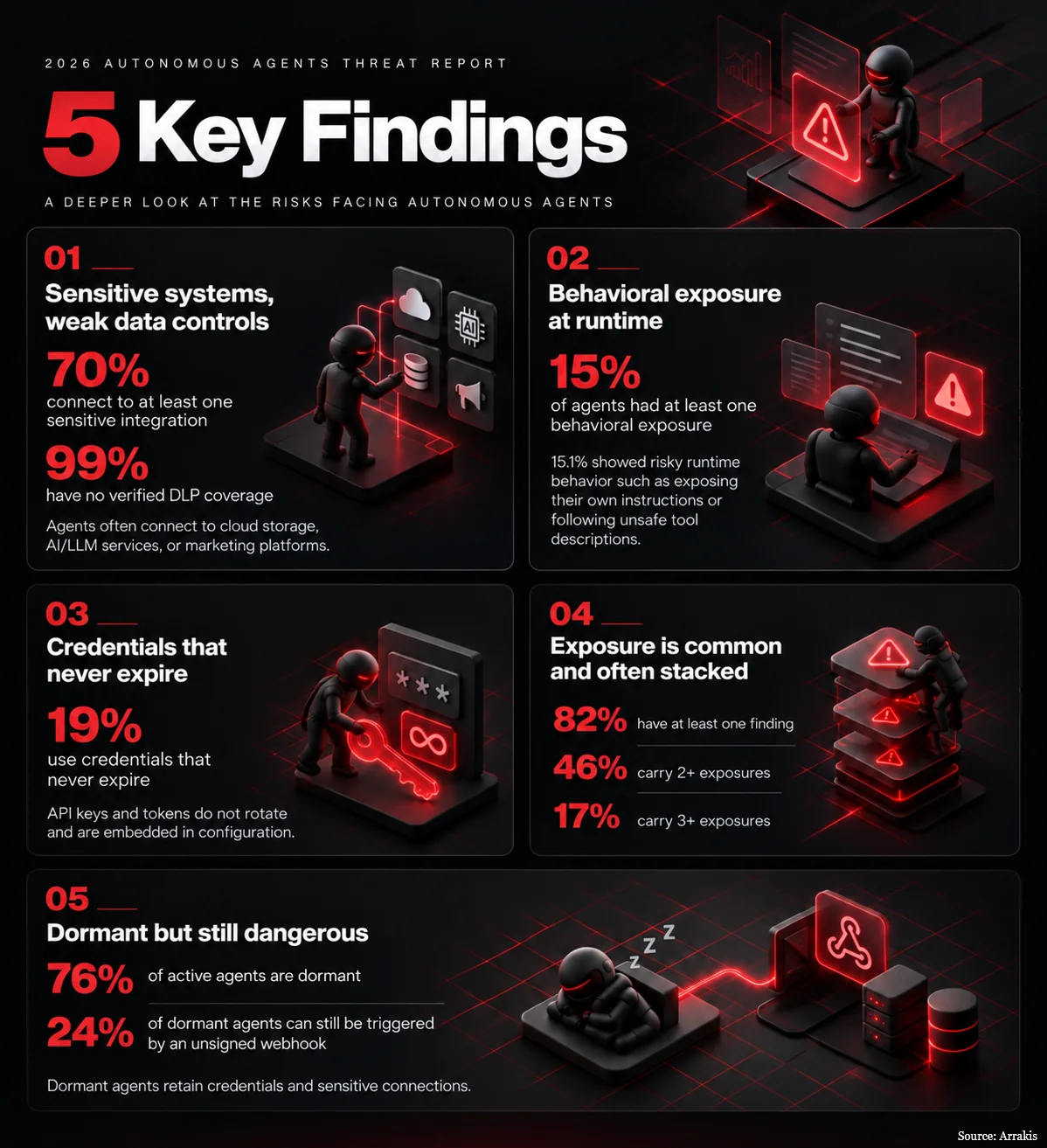
- 82% of autonomous agents have at least one security exposure, and 46% of exposed agents carry multiple vulnerabilities.
- 70% of agents connect to sensitive systems, while 99.4% of those agents lack verified DLP coverage on those connections.
- 76% of active agents are dormant but retain credentials and system access.
- 24% of dormant agents can still be activated through unsigned external webhooks.
- 15.1% of agents exhibit behavioral exposures, underscoring the need to monitor runtime actions.
As businesses accelerate their adoption of agentic AI, a new security challenge is emerging.
An autonomous agent is not just another software application. It can access sensitive data, call APIs, trigger workflows and delegate tasks to other agents, sometimes operating under entirely different credentials.
AI agent security goes beyond prompts and models
The 2026 Autonomous Agents Threat Report highlights how widespread security exposures have become. 82% of autonomous agents have at least one security exposure, with 46% of exposed agents carrying multiple vulnerabilities.
Access to sensitive systems adds to the concern. 70% of agents connect to sensitive systems, yet 99.4% of those agents have no verified Data Loss Prevention (DLP) coverage on those connections. The challenge is not simply whether an agent can perform its task, but whether its access and data flows are appropriately controlled.
Inactive does not mean harmless
One finding is particularly striking: 76% of active agents are dormant, but retain their credentials and system access. Even more concerning, 24% of dormant agents can still be activated through unsigned external webhooks.
An agent that nobody has used for months could still be triggered externally, with access to the systems and credentials it was originally granted. That makes dormant agents an operational risk even when they are not doing any useful work.
Runtime behavior creates a different kind of risk
The risks extend beyond configuration weaknesses. 15.1% of agents exhibited behavioral exposures, including following untrusted tool descriptions or revealing internal instructions.
Permissions and configuration matter, but they are only part of the picture. Organizations also need visibility into what an agent actually does as it carries out tasks.
Make governance part of deployment from day one
AI agent governance should become part of enterprise security and operational management, rather than an afterthought once agents are already connected to business systems.
Before deploying more agents, organizations should ask:
- Do we know which agents exist and who owns them?
- Are their permissions limited to what they actually need?
- Can we monitor their actions and immediately revoke access when necessary?
The next challenge in agentic AI adoption is not just making agents more capable. It is ensuring they remain accountable and controllable.
How is your organization approaching AI agent security and governance?
Source / Further reading: 2026 Autonomous Agents Threat Report - Arrakis Security Research