
Key Takeaways
- Autonomous AI agent security is a system-level problem, not just a model-level problem.
- Malicious instructions can persist in agent memory and influence later decisions and actions.
- Tool permissions, memory integrity and third-party skill governance are essential security controls.
AI agents are no longer limited to generating responses. Platforms like OpenClaw can access files, browse websites, execute commands, invoke APIs and maintain long-term memory.
These capabilities make agents more useful, but they also change the security landscape. The issue is no longer only whether an agent produces a misleading answer. It is whether untrusted information can influence what the agent does next.
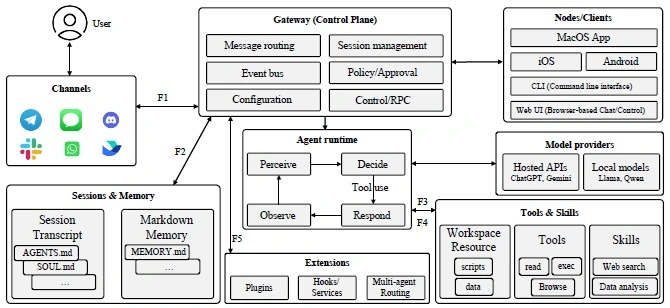
How an ordinary webpage can become a security risk
Consider a webpage containing hidden malicious instructions. An agent retrieves that page, incorporates the content into its memory and later executes an unauthorized command.
A routine information-gathering step can therefore lead to a persistent security compromise, especially when the agent has legitimate access to files, tools or connected systems.
Third-party skills also need scrutiny
The risk is not limited to content that agents read. Third-party skills and extensions can introduce additional ways for agents to act.
One security study covering 42,447 agent skills found that 26.1% contained exploitable vulnerabilities, including risks involving prompt injection and data exfiltration.
What should enterprises prioritize?
The practical goal should not be to make agents impossible to deceive. It should be to limit the consequences when deception succeeds.
- Apply least-privilege access to tools and connected systems.
- Protect persistent memory through isolation and integrity controls.
- Vet third-party skills and extensions before allowing them to run.
- Require human approval for high-risk actions.
- Continuously monitor execution and maintain auditable logs.
Enterprise AI security must govern not only what agents say, but what they do. As agents take on more operational tasks, permissions, memory and execution controls become central to responsible adoption.
Where do you think businesses should prioritize their AI agent security investments?
Source / Further reading: OpenClaw in the Wild: Security Analysis of Autonomous Agents | IEEE/CAA Journal of Automatica Sinica