Key Takeaways
- 45% of surveyed security practitioners identify endpoint agents such as Claude Code and Codex as their primary AI security concern.
- Dedicated AI security budgets increased from 8% to 37% of surveyed organizations within one year.
- Granular permissions, MCP and Skills governance, and intent-based runtime controls are becoming critical.
- Existing security platforms can address many internally developed agent requirements; remaining gaps should guide new purchases.
AI security is entering its second era. The first focused largely on Shadow AI, data leakage, and controlling employee access to tools like ChatGPT. Now the focus is shifting to agents that can execute commands, access internal systems, and take action on our behalf.
That changes the security question. It is no longer just about what information someone shares with an AI tool. It is also about what an agent can do once it has access.
How AI security priorities are changing
In Latio’s 2026 AI Security Market Report, 45% of surveyed security practitioners identified endpoint agents such as Claude Code and Codex as their primary AI security concern. The proportion of surveyed organizations allocating a dedicated AI security budget increased from 8% to 37% within one year.
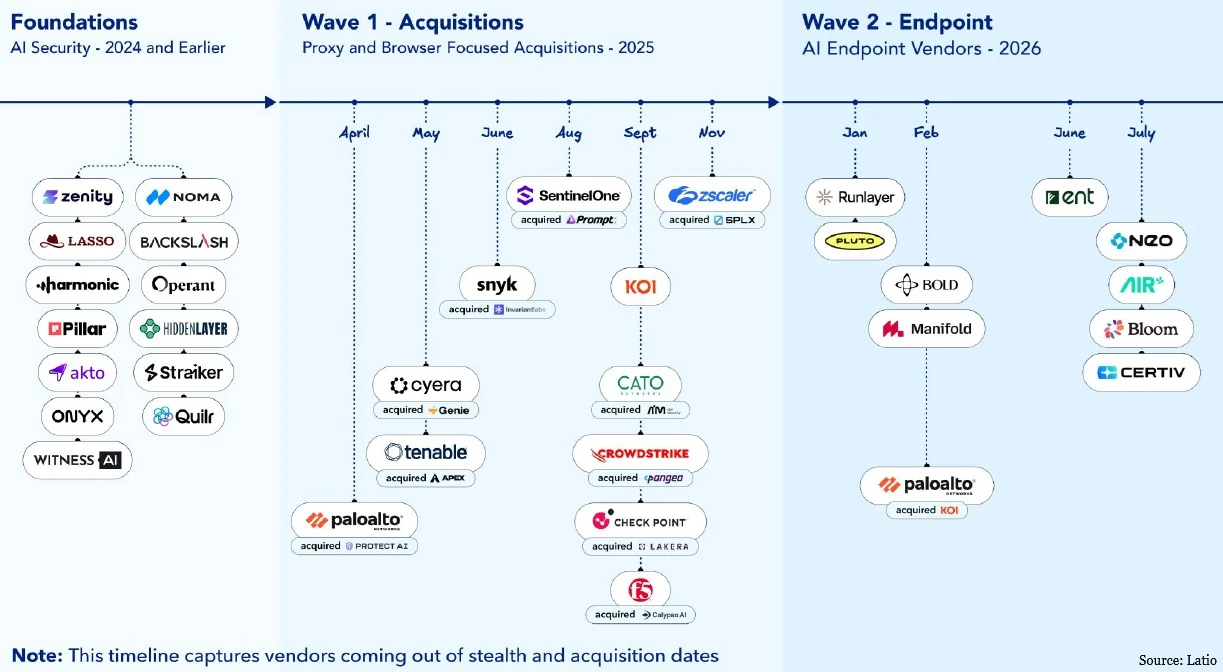
The timeline captures the progression from earlier AI security vendors through browser- and proxy-focused acquisitions in 2025 to endpoint-focused providers in 2026. Roughly 400 AI security startups now compete in this fast-changing market.
Why agent permissions matter
An AI agent does not need malicious intent to cause damage. Excessive permissions, compromised Skills, or unintended actions may be enough. The practical question is whether an organization knows which files, credentials, tools, and enterprise systems its agents can reach.
Visibility alone is not sufficient. Granular permissions, MCP and Skills governance, and intent-based runtime controls are becoming critical to detecting unexpected behavior and limiting what an agent can execute.
What enterprises should prioritize
Before buying another security product, start by understanding the agents already in use, the permissions they have, and the actions they are allowed to perform. Existing security platforms can cover many needs, particularly for internally developed agents. The priority is to identify where gaps remain in access control, tool execution, and runtime enforcement.
Security strategies will need to keep evolving as agents increasingly move from employee endpoints to cloud-hosted environments. The real challenge is to make agents safe enough to trust with meaningful work without removing the autonomy that makes them useful.
How is your organization approaching AI agent security? Are existing controls sufficient, or is a dedicated layer becoming necessary?
Source / Further reading: 2026 AI Security Market Report by Latio.