Key Takeaways
- Identify two or three high-impact tasks rather than experimenting with AI tools at random.
- Prioritise use cases with meaningful impact and low implementation friction.
- Use AI as a creator, analyst, strategist or researcher, based on the work to be improved.
A lot of professionals are stuck in the same AI loop: they open a tool, ask a few random questions, get average results, and conclude that AI is overhyped.
The problem is often not the technology. It is the lack of a clear use case.
Four practical roles AI can play at work
One useful starting point is to think about AI in terms of four roles:
- Creator: Drafts content, decks, templates, visuals, code and prototypes.
- Analyst: Finds patterns in data, surveys, feedback and operational information.
- Strategist: Helps frame decisions, evaluate options and pressure-test thinking.
- Researcher: Gathers and synthesises information across internal or external sources.
These roles help teams move beyond random experiments and connect AI to actual work.
Prioritise by impact and ease
Not every AI idea is worth pursuing first. Identify two or three high-impact tasks, then compare them using an Impact vs Ease matrix. The strongest early candidates sit in the top-right quadrant: they promise meaningful impact, face relatively little implementation friction and can be tested quickly.
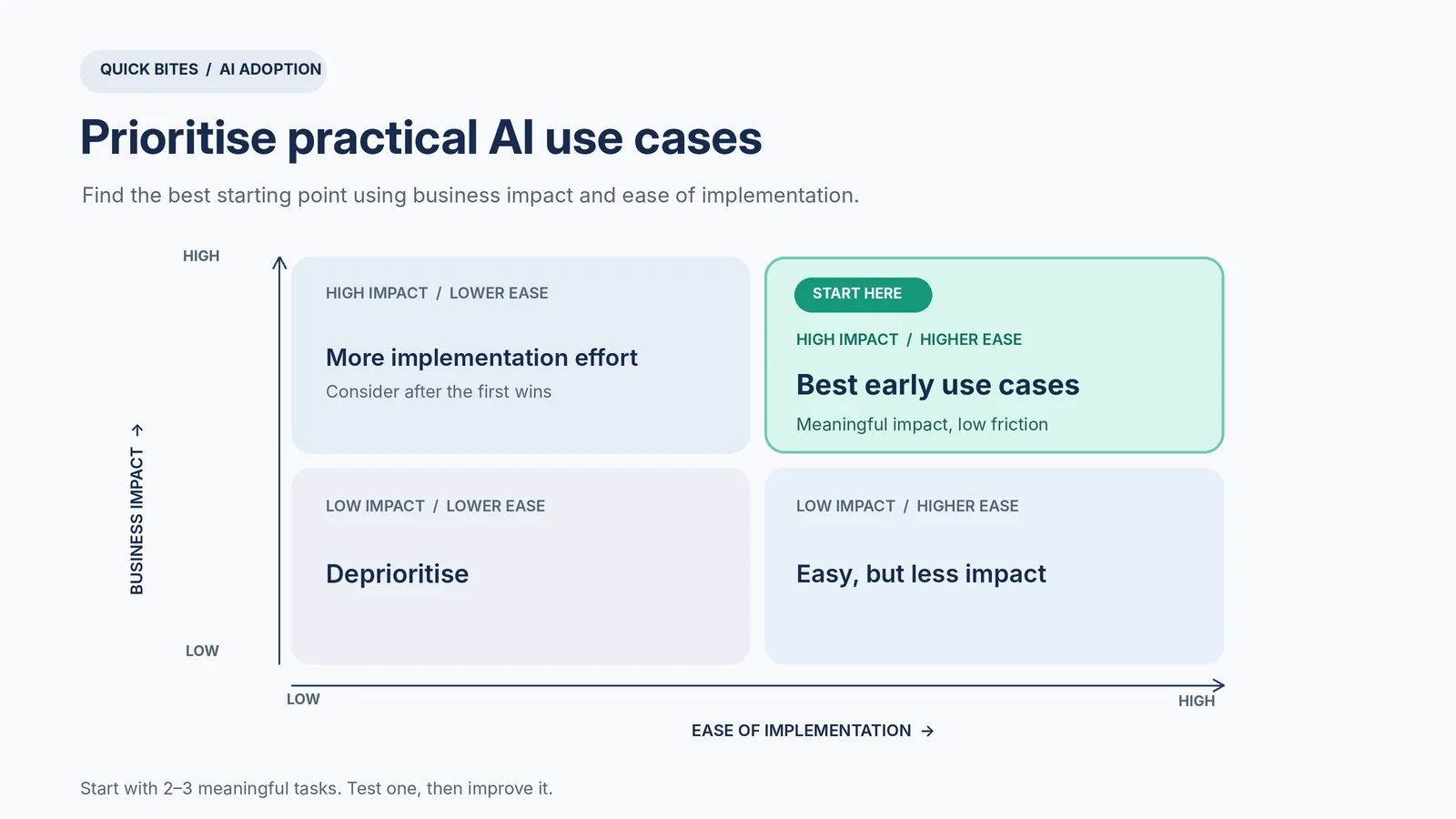
The point is not to automate everything at once. It is to find a useful first improvement and learn from a focused test.
Start with the task, not the tool
For business leaders, AI adoption should not begin with “Which tool should we buy?” It should begin with “Which task should we improve first?”
Pick one task. Build the prompt. Test it this week. Then improve it.
What AI use case would create the most immediate value in your team today?