
Key Takeaways
- AGI could automate all economically essential work, making compute the main driver of long-run growth.
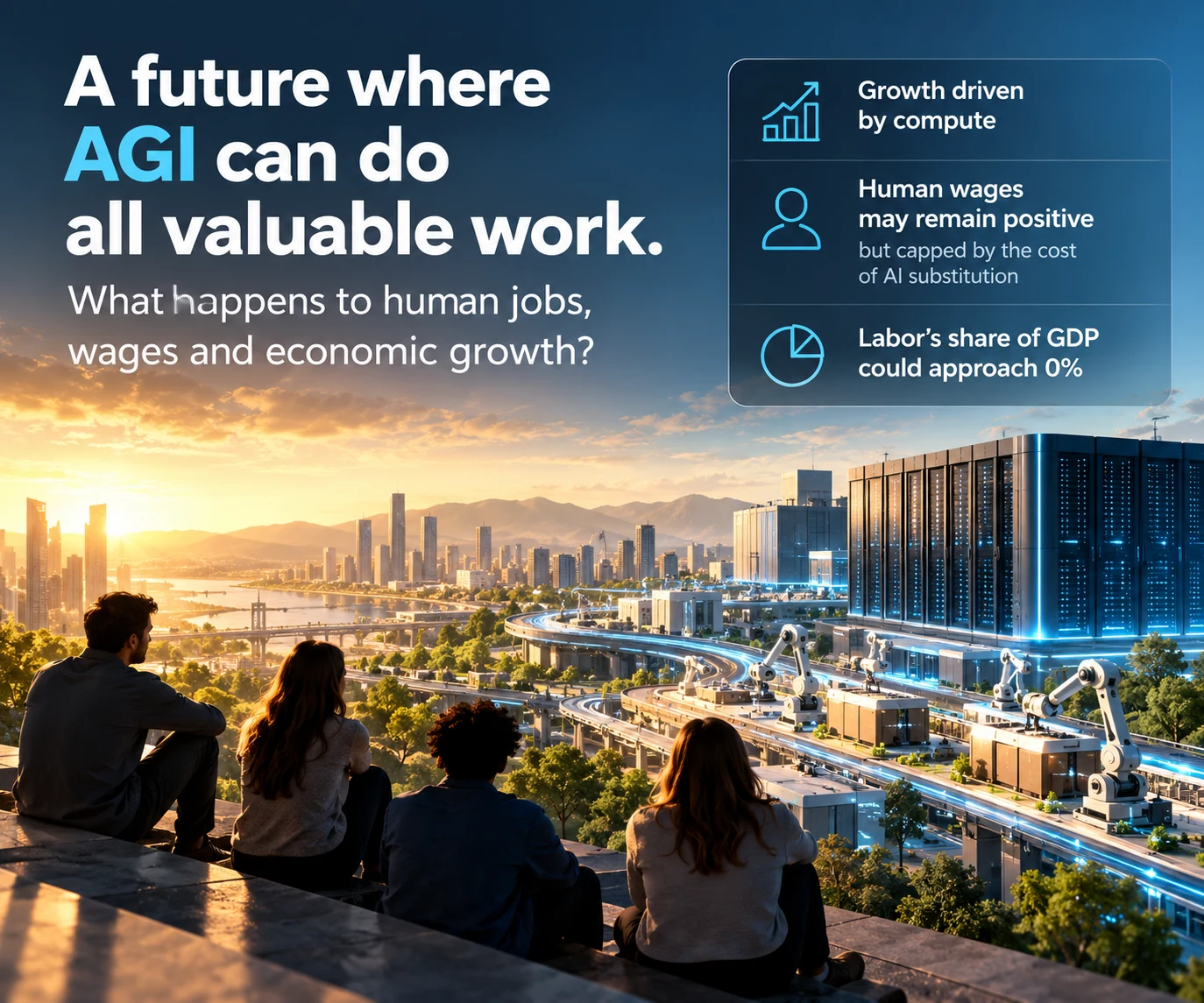
- Human wages may remain positive even as labor’s share of GDP approaches zero.
- The distribution of AI-generated wealth may become as important as the productivity gains themselves.
A theoretical future in which artificial general intelligence (AGI) can perform all economically valuable work raises an important question: what happens to human labor when growth no longer depends on it?
In an NBER working paper, economist Pascual Restrepo examines how growing computational resources could reshape production, wages and the distribution of income. One of the most striking implications is that labor's share of GDP could approach 0% while compute's share approaches 100%.
That does not necessarily mean humans stop working or that their wages disappear.
Essential work and supplementary work
The distinction is between two kinds of economically valuable activity:
- Bottleneck work: Work essential for sustained economic growth, including energy production, logistics and scientific research.
- Supplementary work: Work that remains valuable but is not essential for continued growth, including hospitality, entertainment and the arts.
In this theoretical AGI economy, all bottleneck work eventually becomes automated, while some supplementary work may remain in human hands. Compute becomes the primary driver of further economic expansion.
Why human wages may stop tracking economic growth
People may continue working and earning positive wages, potentially even above pre-AGI levels. But the value of their work would increasingly be bounded by the computing cost of replicating their skills.
As a result, the economy could keep expanding without comparable growth in wages. Greater prosperity would not automatically translate into a greater share of income for labor.
The bigger question for business and society
For business leaders, this changes how we think about automation, productivity and value creation. The question is not only which tasks AI can perform, but also how the resulting economic value is generated and who captures it.
The implications extend beyond job displacement to ownership, wealth distribution and the purpose of work itself.
What will be the bigger challenge in an AGI economy: finding meaningful work for humans, or ensuring that AI-generated prosperity is broadly shared?
Source / Further reading: We Won't Be Missed: Work and Growth in the AGI World | National Bureau of Economic Research