Key Takeaways
- 79% of surveyed enterprises run AI agents in production, but only 2% use agent-specific identity security tools.
- 60% of organizations remain at the two lowest levels of identity security maturity.
- 62% report notable productivity gains from securing non-human identities, showing that governance can support business speed.
Enterprises are giving AI agents the ability to query databases, execute transactions and make decisions on behalf of the business. The challenge is making sure those capabilities are governed without introducing new delays.
SailPoint's Horizons of Identity Security 2026–2027 report highlights the gap. While 79% of surveyed enterprises already run AI agents in production, only 2% use identity security tools specifically designed for agents. Some 60% of organizations are still at the two lowest levels of identity security maturity.
Why traditional identity controls fall short
Many organizations still manage AI agents using access processes designed for employees. Those processes are familiar, but they do not necessarily match how autonomous software operates. An agent may need to act immediately, across several systems, and only for the duration of a particular task.
The bigger issue is not simply which security tools an enterprise owns. It is whether the governance model can establish accountability, set appropriate permissions and keep up with agent activity.
Start with ownership and access boundaries
Four practical questions should shape any deployment of autonomous agents:
- Who owns each AI agent and is accountable for its actions?
- Which systems and sensitive data does the agent genuinely need to access?
- Should its permissions remain active after its task is complete?
- Can its actions be traced to the human or workflow that authorized them?
These may sound like basic governance questions, yet only 15% of surveyed organizations can provision non-human access in real time.
Build the foundation before automating enforcement
A practical starting point is to discover and catalog AI agents, assign accountable owners, and apply least-privilege access. As these foundations mature, enterprises can introduce just-in-time authorization and continuous monitoring.
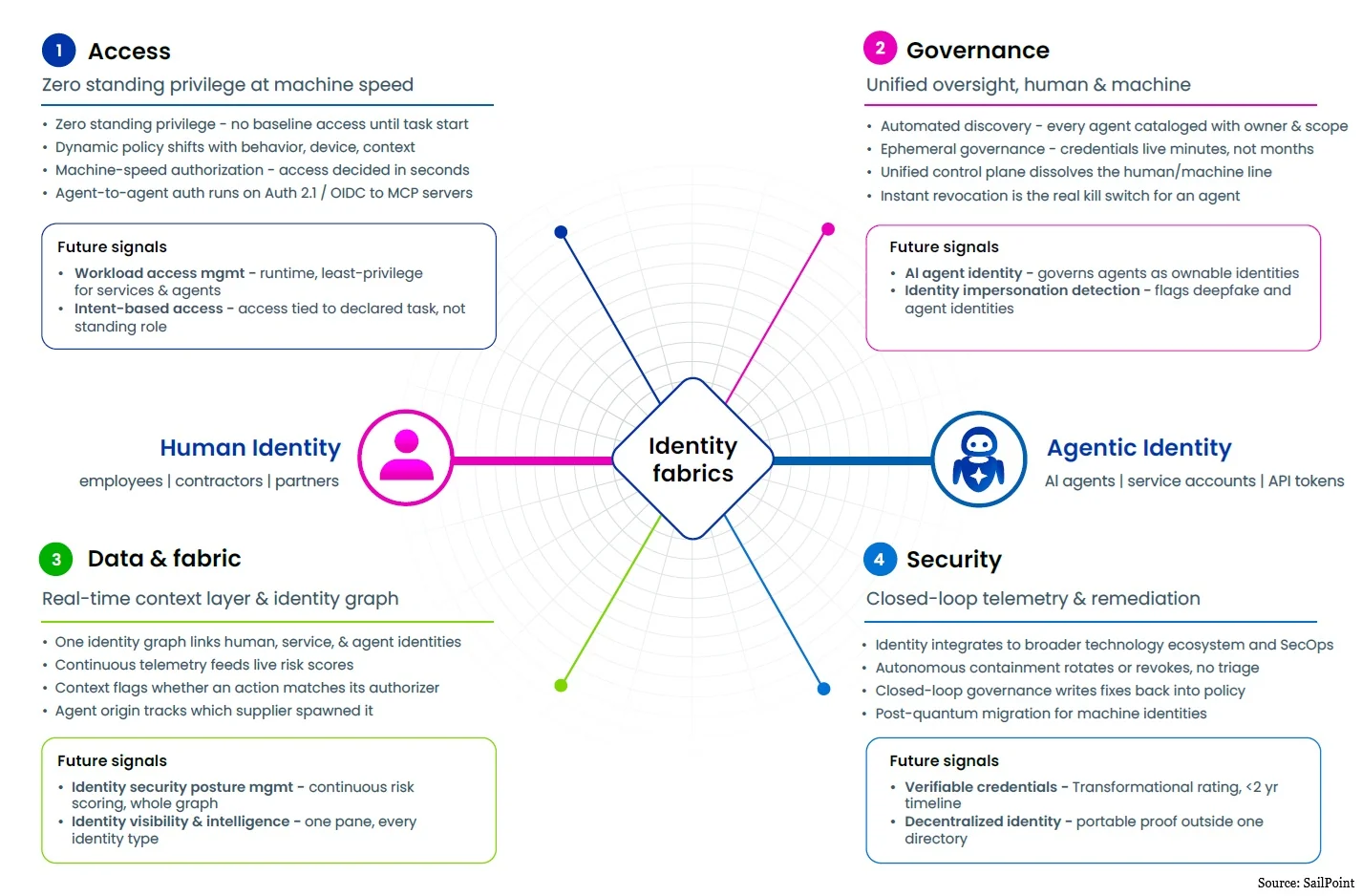
The accompanying identity fabric model connects four capabilities: access, governance, data and security. Together, they help organizations manage who or what is acting, why access is granted, and how activity is monitored and controlled.
Security should not be treated solely as a constraint on AI adoption. In the survey, 62% of organizations reported notable productivity improvements from securing non-human identities, while 46% reported safer, faster AI deployment.
The strategic takeaway: The ability to build AI agents is advancing faster than the ability to govern them. Enterprises that make identity security part of their AI architecture from the beginning will be better positioned to scale automation responsibly.
How is your organization approaching identity management and accountability for AI agents?
Source / Further reading: The Horizons of Identity Security 2026–2027 — SailPoint