Key Takeaways
- 46.1% of assessed tasks received positive worker ratings for automation, chiefly to free up time for higher-value work.
- 45.2% of occupations favoured equal human-AI partnership as the dominant worker-preferred arrangement.
- 31.6% of tasks fell into the Red Light zone, where AI capability was high but worker desire for automation was low.
- Workers and AI experts agreed on the preferred level of human involvement for only 26.9% of tasks.
Deciding what to automate with AI agents is not simply a technical exercise. The more useful question is whether automation matches the needs of the people doing the work.
A Stanford study involving 1,500 workers and 52 AI experts across 104 occupations reveals a disconnect between what AI can do and what workers actually want it to do.
Technical capability is only half the equation
Workers gave positive automation ratings to 46.1% of tasks, primarily because they wanted to free up time for higher-value work. Yet 31.6% of tasks fell into the "Red Light" zone, where AI could automate the work but workers showed limited desire for it.
This distinction matters for enterprise adoption. Asking only whether an agent can complete a task overlooks whether people want to delegate it and where they expect to retain control.
Not every task needs the same level of autonomy
The researchers introduced the Human Agency Scale (H1 to H5), which distinguishes fully autonomous task execution from varying degrees of human-AI collaboration and human-led work.
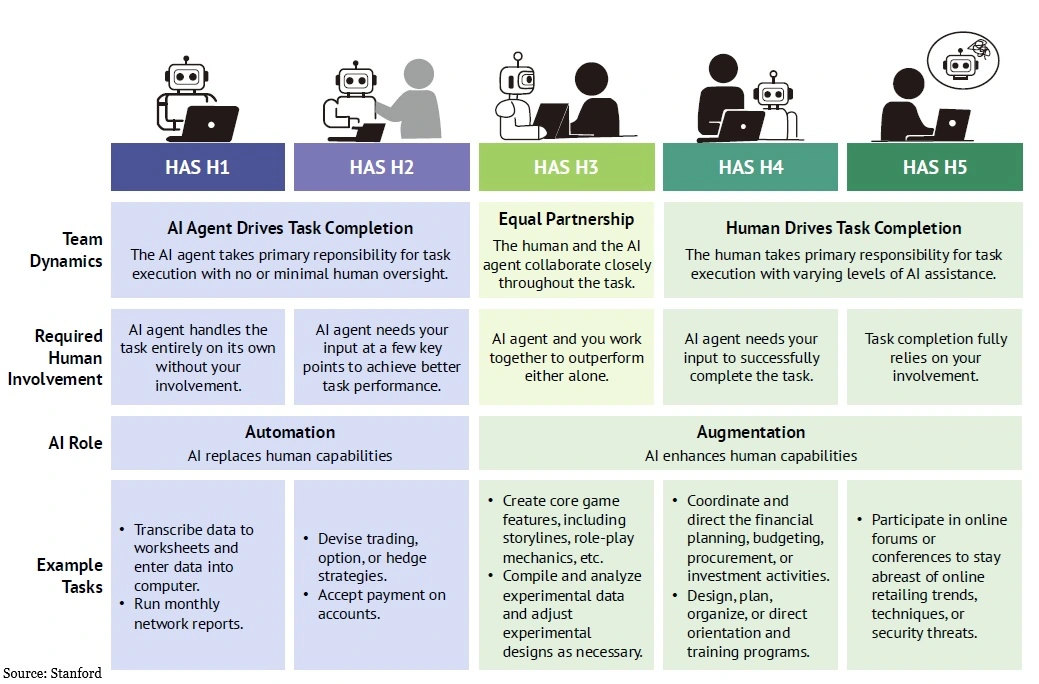
Equal human-AI partnership was the dominant worker preference in 45.2% of occupations. Workers and AI experts agreed on the appropriate level of human involvement for only 26.9% of tasks, with workers generally preferring more control than experts considered technically necessary.
Prioritise the right work, not the most automation
For business leaders, a practical starting point is to assess opportunities at the task level. Consider technological feasibility, worker preferences, and the degree of human involvement needed for effective execution.
The goal should not be maximum automation. It should be the right balance between automation and augmentation.
What do you think? Should workers have a greater say in deciding which parts of their jobs AI agents take over?
Source / Further reading: Future of Work with AI Agents: Auditing Automation and Augmentation Potential across the U.S. Workforce, Stanford University