Key Takeaways
- 61% of surveyed SMEs use AI, but 76% of adopters are classified as AI Novices.
- Only 21% report significant or transformational business benefits from AI.
- Among Japanese SMEs, reported transformational impact rises from 2% for isolated AI use to 23% for enterprise-wide use.
- Maintenance costs, limited training time and weak cybersecurity readiness remain key barriers.
AI adoption is accelerating among small and medium-sized enterprises. But putting an AI tool in employees’ hands is not the same as changing how a business operates.
The OECD’s 2026 D4SME Survey covered more than 2,000 SMEs across 12 countries. While 61% of respondents use AI, 76% of adopters are classified as “AI Novices”, relying largely on tools for isolated tasks.
Widespread adoption, limited integration
Most SMEs are starting with accessible applications. Among users of off-the-shelf AI, 70% use it for marketing content creation and 56% for document drafting. These are useful entry points, but they do not necessarily change the way work flows across the organisation.
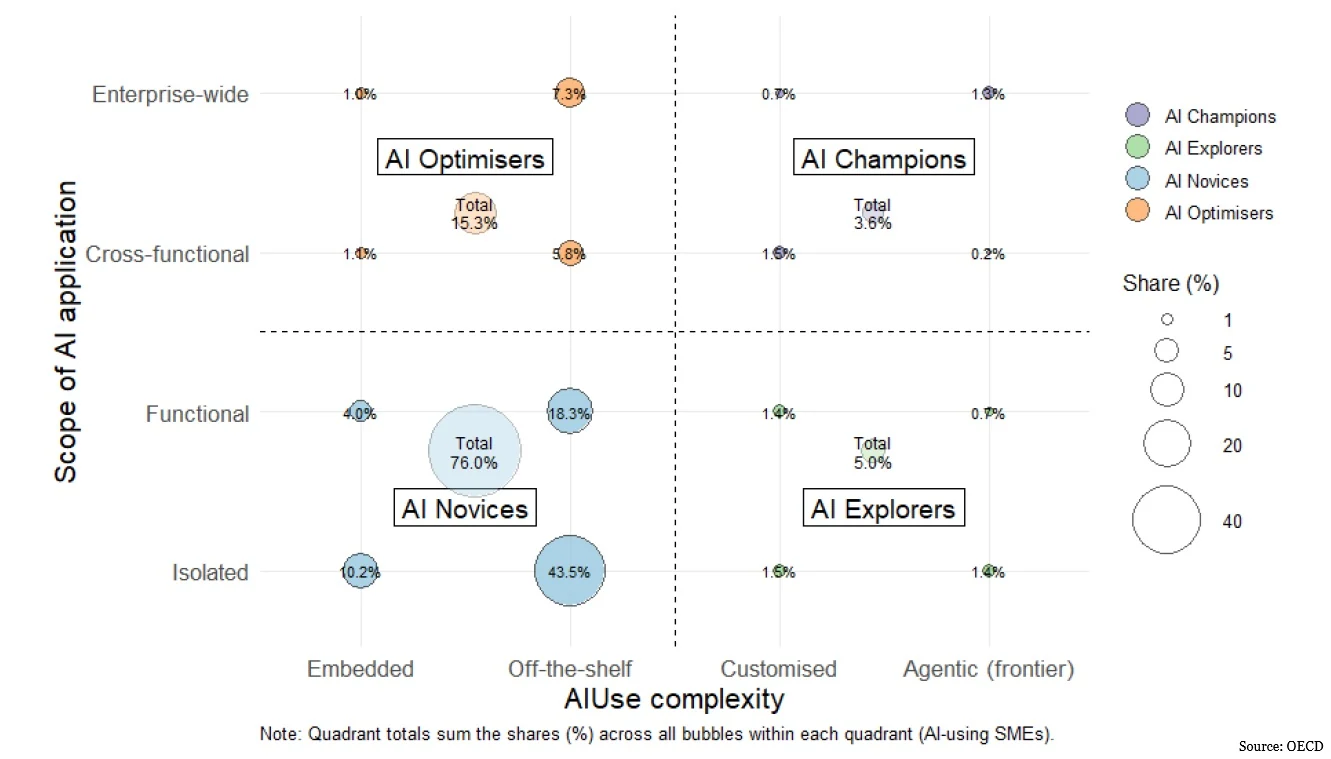
The chart puts the maturity gap into perspective. Only 5% of surveyed firms use customised AI, while 3.6% deploy agentic AI. More sophisticated and broadly integrated approaches remain uncommon.
Business impact depends on how AI is used
Only 21% of surveyed SMEs report significant or transformational benefits from AI. This raises a practical question for business leaders: are we counting tools adopted, or improvements achieved?
The Japanese survey responses show why scope matters. Transformational impact was reported by just 2% of SMEs using AI for isolated tasks, compared with 23% of those deploying it enterprise-wide. This is a self-reported association, not proof that broader deployment by itself causes better outcomes.
The barriers are operational, not just technical
SMEs face familiar implementation constraints. Maintenance costs are cited by 39%, while 38% report insufficient time for training. Cybersecurity is another weakness: 46% have no or only minimal protective measures in place.
These constraints matter because lasting AI adoption requires more than access to a model. Teams need the time, skills and security practices to integrate tools into day-to-day work.
Where SME leaders should focus next
- Prioritise valuable processes. Start with work where better integration could improve operational outcomes, not simply with tasks where AI is easy to try.
- Connect AI to existing workflows. Look beyond standalone assistance towards processes that span business functions.
- Build capability and security alongside deployment. Address training needs and cybersecurity readiness as part of implementation.
- Measure business impact. Evaluate AI by the operational improvements it delivers, rather than the number of tools introduced.
The strategic priority should shift from deploying more AI tools to achieving measurable business outcomes through secure, well-integrated automation.
The survey sample is not representative of all SMEs, but the distinction it highlights is valuable: adoption is only the starting point.
Are SMEs investing enough in redesigning business processes, or are they simply adding AI tools to existing ways of working?
Source / Further reading: Empowering SMEs in the age of AI: The 2026 OECD D4SME Survey (OECD)