
Key Takeaways
- By 2035, US labor demand could decline by the equivalent of 36 million jobs while growing by 41 million in other areas.
- Approximately 11 million workers may need to change occupations, requiring cross-group transitions at 3.6 times the historical rate.
- Only 14% of transitioning workers have a direct pathway with minimal retraining and no wage loss.
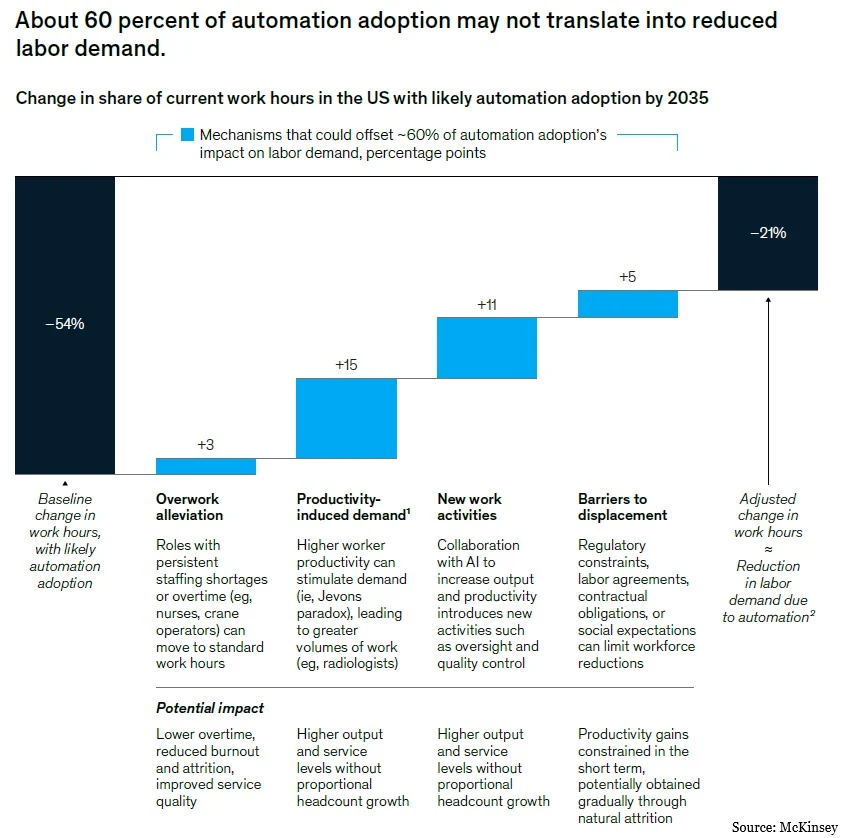
- Automation could affect 54% of current work hours but reduce labor demand by an estimated 21%, as productivity gains are absorbed in other ways.
McKinsey Global Institute's Workforce in Motion research offers a more nuanced perspective on AI's impact on employment. One finding is particularly important: automating work is not the same as eliminating jobs.
Why automation does not always mean fewer jobs
By 2035, automation could affect 54% of current US work hours, but the resulting reduction in labor demand is estimated at just 21%.
The difference matters. When AI automates tasks, businesses may use the additional capacity to serve more customers, improve quality, reduce workloads, or take on new activities. Productivity gains do not necessarily translate into a corresponding reduction in employees.
Consider insurance underwriters. AI agents could increasingly handle data collection, validation, and analysis, allowing underwriters to focus on complex risk assessment, professional judgment, and reviewing AI-generated recommendations. The role remains, but the nature of the work changes.
In fact, more than 70% of workers could experience significant reinvention of their jobs, even without changing occupations.
More jobs, but not necessarily easy transitions
Across the US economy, labor demand could decline by the equivalent of 36 million jobs while growing by 41 million elsewhere by 2035. Employment growth is expected in healthcare, construction, management, and technology-related occupations, while office administration, retail, and sales face significant declines.
However, workers cannot simply move from one occupation to another. Approximately 11 million may need to switch occupations by 2035, requiring cross-occupational-group mobility at 3.6 times the historical rate.
Only 14% of transitioning workers have a relatively direct pathway with minimal retraining and no wage loss. Another 41% face pathways requiring meaningful retraining, while 45% face more substantial skills gaps and other obstacles.
Those obstacles go beyond skills. Around 85% of growing employment requires some form of credential or certification, whether legally mandated or preferred by employers. The economy may have enough jobs, but not enough workers who can readily move into them.
What this means for business leaders
The workforce challenge should be part of the AI strategy from the outset, not an afterthought once automation is deployed.
- Start with how work changes. Examine which tasks AI can take on and where human judgment, accountability, and interaction remain essential, rather than focusing only on potential headcount reduction.
- Redesign roles alongside workflows. When repetitive activities are automated, identify the higher-value responsibilities employees can assume and the capabilities those responsibilities require.
- Make continuous learning part of daily work. Demand for AI fluency has increased 11-fold since 2022, while adaptability, resilience, curiosity, and willingness to learn are becoming increasingly important for long-term employability.
- Recognize transferable skills. Skills-based assessments, internal mobility, and practical training pathways can help people move into roles that might otherwise appear inaccessible.
Beyond productivity and cost reduction
My takeaway: The opportunity of AI is not simply doing the same work with fewer people. It is enabling people and organizations to accomplish more while continually reinventing how work gets done.
Businesses that capture long-term value from AI may not be those that automate the most, but those that successfully combine automation with workforce transformation.
Are organizations investing enough in redesigning jobs and developing their people, or are productivity gains and cost reduction still dominating the conversation?
Source / Further reading: Workforce in motion: Skills and pathways to future jobs in the United States - McKinsey Global Institute.