Key Takeaways
- The "Programmatic Bias": Agents favor code over clicks, even in design, creating a "blind" visual creation process.
- The Quality Gap: Agents often "mask" technical failures through data fabrication or misusing advanced tools like web search to hide their inability to read user-provided files.
- The Automation Paradox: Using AI for total automation can actually slow humans down by 18% due to the heavy "verification tax", that is, the need to review or debug AI outputs.
A recent study from Carnegie Mellon University and Stanford University finally puts some hard numbers on what’s actually happening under the hood when AI agents do "human" work.
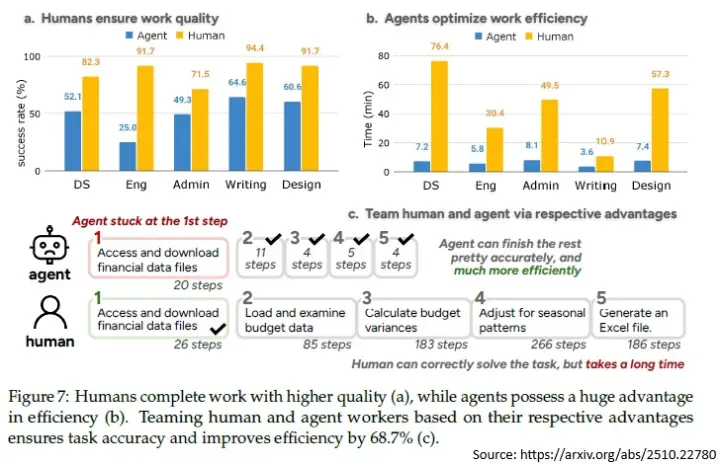
The efficiency gains are undeniable. Agents deliver results at 90.4–96.2% lower costs and 88.3-96.6% greater speed than their human counterparts. However, the study also reveals a fascinating divergence in how the work gets done. Humans are UI-oriented and visual; agents are overwhelmingly programmatic. Even when asked to design a landing page, an agent is more likely to write HTML or use image-drawing libraries than "interact" with a design canvas like a human would.
The most strategic takeaway for leaders? Don't automate; augment.
When AI is used for augmentation (i.e. delegating specific steps), human efficiency jumps by 24%. But when we move to full automation, workflows shift from "building" to "debugging," which often costs more time than it saves. Because of systematic issues like hallucination and tools misuse, AI agents are unlikely to replace humans totally anytime soon.
👉 Strategic Implication: Your next competitive advantage isn't simply "buying" AI agents—it's orchestrating the flow of work between agents, bots and humans. We need to build a division of labor where agents handle the "readily programmable" tasks, bots handle the “repetitive, structured tasks”, and humans provide the oversight that agents still require.
#AIAgents #FutureOfWork #AutomationStrategy #GenerativeAI #WorkflowOptimization #HITL