Key Takeaways
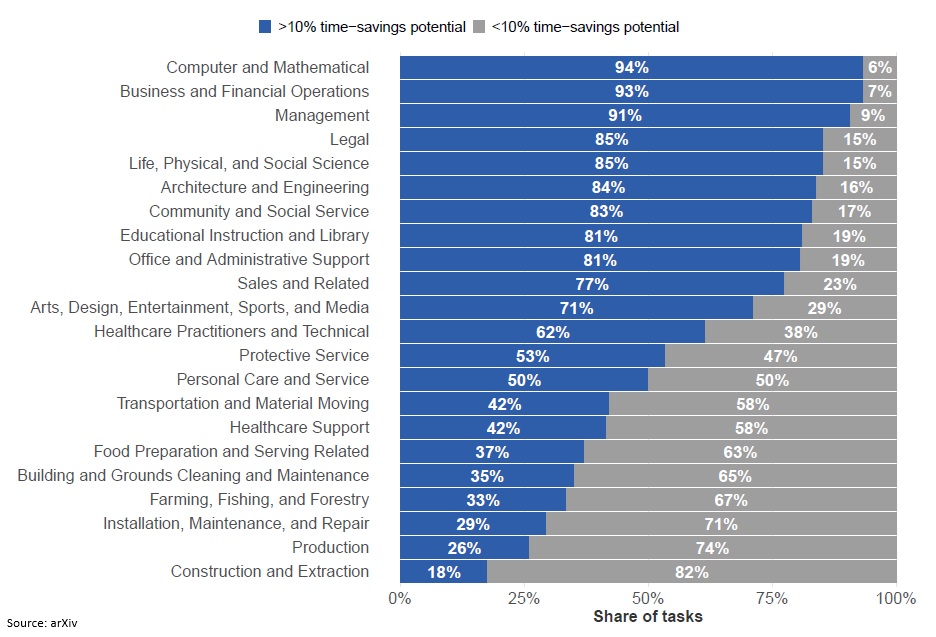
- More than 17,000 worker evaluations across 3,000+ tasks found stronger evidence of “rising tides” than “crashing waves.”
- By 2025 Q3, frontier models reached around 65% success on tasks that take humans 3 to 4 hours.
- If current trends continue, many text-based tasks could reach 80% to 95% AI success rates by 2029 at minimally sufficient quality.
The interesting part is not just that AI is improving.
It is how it is improving.
The MIT study “Crashing Waves vs. Rising Tides: Preliminary Findings on AI Automation from Thousands of Worker Evaluations of Labor Market Tasks” suggests AI progress is not only about models suddenly becoming good at one narrow category of work. Instead, performance is rising across a wide range of text-based tasks.
That matters for leaders.
A “crashing wave” would mean sudden shocks. One task looks safe, then quickly becomes automatable.
A “rising tide” is different. It gives organizations more visibility, but also creates a broader management challenge.
This is not just a technology question.
It becomes an operating model question.
👉 Which tasks should be redesigned?
👉 Where should human review remain?
👉 Which workflows need better context, data access, and governance?
👉 Which roles need to shift from doing the work to supervising, validating, and improving AI-assisted work?
The paper also makes an important distinction: task capability does not equal real-world automation.
Deployment still depends on adoption, integration, regulation, cost, and the messy “last mile” of enterprise operations.
The key takeaway: leaders should stop asking only “which jobs will AI replace?”
The better question is:
Which parts of work are becoming AI-addressable, and how do we redesign the system around that?
What do you think this means for AI adoption over the next 12 months?
#AI #Automation #FutureOfWork #EnterpriseAI #AIAutomation #BusinessTransformation #AIAdoptionStrategy