Key Takeaways
- Mass adoption: ChatGPT’s growth has no precedent—18 billion messages a week, with fastest adoption in lower-income countries
- Top use cases: Practical Guidance, Seeking Information, and Writing make up nearly 80% of all conversations
- Work patterns: Writing dominates work-related use, but “asking” messages (decision-support) are growing fastest—reflecting how AI enhances thinking, not just doing
The NBER study “How People Use ChatGPT” (Chatterji et al., 2025) offers the first large-scale empirical view of how humans interact with generative AI in the wild. It analyzed millions of messages using a privacy-preserving classification pipeline to map usage across work, education, and personal life.
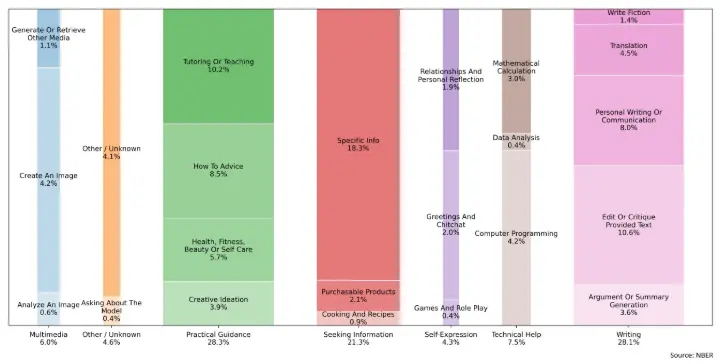
Some striking findings:
1️⃣Work vs. Life: Non-work messages rose from 53% to 73% in just one year—suggesting that ChatGPT is now as much a “home productivity” tool as it is a work aid.
2️⃣ Writing Rules: 40% of work-related messages involve writing, editing, or summarizing—skills central to white-collar work.
3️⃣ Asking Beats Doing: Nearly half of all messages are ‘asking’—seeking clarity, insight, or judgment. The authors link this to decision support, which may be where AI adds the most lasting economic value.
4️⃣ Democratization in action: Usage surged in lower-income countries and among younger users, with the gender gap narrowing to near parity by mid-2025.
🔸 Strategic takeaway: This report captures a pivotal shift—from AI as a tool for output to AI as a thought partner and life coach. The next frontier for automation leaders isn’t just coding or document generation—it’s agentic systems that understand intent, context, and decision flow. We’re entering the age of cognitive collaboration, where AI doesn’t just execute—it augments how we think.
#AI #Automation #ChatGPT #AgenticAI #FutureOfWork #DigitalTransformation #GenerativeAI
How are people really using ChatGPT and what does it tell us about the future of work and AI?