Key Takeaways
- AI-native firms embed AI directly into workflows, remove unnecessary human handoffs, and scale with agents instead of headcount.
- The real advantage comes from allocating work intelligently across humans, RPA bots, and AI agents.
- In the long run, every employee will need to think less like an operator and more like a builder/orchestrator.
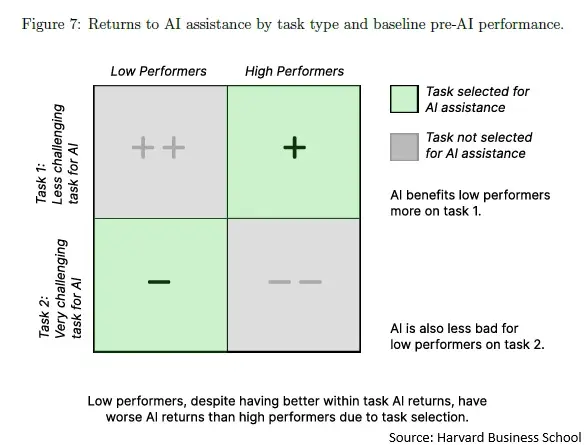
Research by Harvard Business School on 640 Kenyan small business owners found AI had an uneven impact: stronger businesses improved, while weaker ones often declined with AI advice.
The problem is a lot of companies are still treating AI like a productivity plugin.
That feels too small.
The bigger shift is becoming an AI-native firm. That means embedding AI directly into workflows, taking humans out of the loop where judgment is not needed, and building operating models that scale with agents, not just more people.
But that alone is not enough.
The real challenge is becoming a good allocator of intelligence. Which work should stay with humans? Which should go to bots? Which should be handled by agents or models? That question applies not just to companies, but to how we run our own lives and teams too.
What makes this even more interesting is that AI can play two very different roles.
It can be an equalizer, helping slower firms catch up. Or it can be an amplifier, helping stronger firms widen the gap. Either way, human judgment still matters because AI outputs still need to be interpreted, challenged, and directed.
We think agentic AI is where the bigger shift happens. Generative AI helps you think and draft. Agentic AI helps you execute, i.e. walk the talk.
And that leads to the final point: every employee needs to become more of a builder, more entrepreneurial, and more willing to orchestrate work instead of just doing work.
That may be the real future of work.
Do you think most firms are ready to operate this way, or are they still stuck in the AI chatbot/assistant phase?
#AI #AgenticAI #Automation #FutureOfWork #DigitalTransformation #AINative
How do AI-native firms actually win?