Key Takeaways
- AI adoption is rising: Year-over-year data show usage increasing from 40% to 45% of the workforce between Q2 and Q3 2025.
- Frequent use still limited: Only about 23% use AI a few times a week or more, and roughly 10% use it daily.
- Uneven landscape: Knowledge-based roles (e.g., tech, finance, professional services) report far higher usage than frontline-heavy industries like retail or manufacturing.
AI isn’t the shiny new tool anymore; it’s becoming woven into everyday workflows, but how workers experience it varies widely.
The latest Gallup workforce data show that nearly half of U.S. employees report using AI at least occasionally on the job.
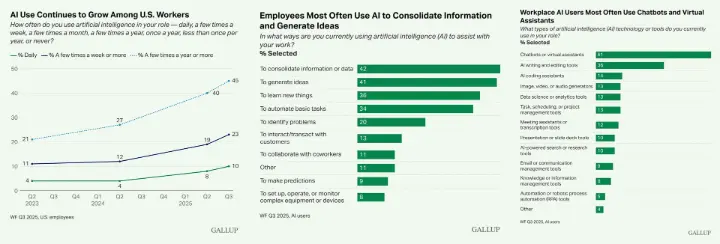
Yet closer inspection reveals an adoption curve with two distinct shapes:
🔹 Broad awareness, moderate frequency: Many people are trying AI, likely for brainstorming, summarization, analysis, or idea consolidation, but most of this use is occasional, not constant.
🔹 Depth of use tied to role and strategy: Employees in technical and professional services roles report the highest engagement with AI, while frontline workers lag significantly. Moreover, frequent users are more likely to adopt advanced tools like coding assistants or analytics platforms.
Perhaps most striking is the mismatch between personal use and organizational clarity. Many workers are utilizing AI even when they’re not sure their employer has a formal AI strategy. Ungoverned AI usage may inadvertently introduce security, privacy, and compliance risks that leaders may not see until it’s too late.
For AI and automation leaders, this suggests a strategic imperative: champion structured adoption, not just casual experimentation. Providing clear guidelines, effective guardrails, role-based training, and alignment with business goals will be what separates useful integration from fragmented adoption.
➡️ Reflection: As AI becomes a staple in professional life, organizations must shift from wondering whether to adopt it, to how to govern it responsibly and effectively.
#AIAdoption #FutureOfWork #AIEthics #Automation #DigitalTransformation #Leadership #WorkplaceInnovation
How many employees in the U.S. are actually using AI at work in 2025?