Key Takeaways
- 95% of large organizations say process automation drove business growth in the past 12 months
- 71% are already using AI agents, but only 11% of agentic use cases reached production last year
- 73% say there is still a gap between their agentic AI vision and reality
According to Camunda’s State of Agentic Orchestration and Automation 2026, enterprise automation is clearly working. Organizations have already automated 48% of their processes on average, and they think that can rise to 64%. Budgets are still moving up too, with 79% planning to increase automation spend and average budgets expected to grow 20% over the next two years.
But AI agents are exposing a different bottleneck.
The issue is not AI adoption. It is governance and AI trust issues.
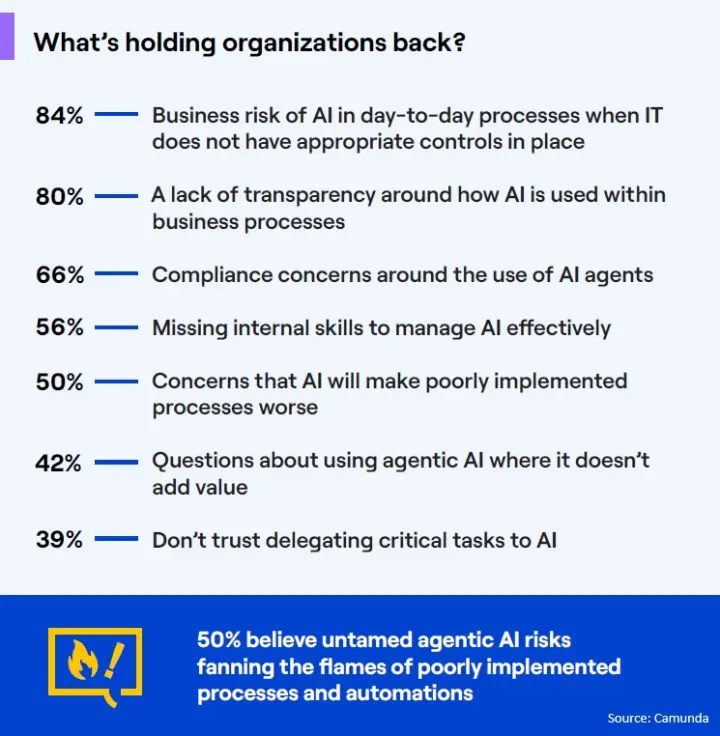
Companies are dealing with rising process complexity: an average of 50 endpoints per process, and more human, system, device, and AI interactions than ever before. At the same time, 84% worry about business risk when AI is used without proper controls, and 80% cite lack of transparency.
Some interesting findings:
🔹 50% believe untamed agentic AI risks fanning the flames of poorly implemented processes and automations
🔹 80% say most of their AI agents today are chatbots or assistants that summarize or answer questions, rather than handling mission-critical cases
🔹 48% say their agents today operate in silos and aren’t woven into end-to-end processes
Our takeaway: standalone agents will create interesting demos, but orchestrated agents will create real business value.
The winners in this next phase will not be the companies with the most agents. They will be the ones that know where agents can act, where humans must approve, and how every step is governed.
Are most companies underinvesting in orchestration and overinvesting in pilots?
#AgenticAI #ProcessAutomation #AIAgents #EnterpriseAI #Orchestration #DigitalTransformation