Do you know?
- Identity threats jumped 850% in 2025 and made up 53% of overall detection volume, up from 20% the year before.
- The browser has become the real frontline because that is where users authenticate, access apps, and expose session tokens, cookies, and credentials.
- AI is acting more as a force multiplier than a fundamentally new attack category, but the bigger enterprise risk may be insecure AI tools and agents with deep access to systems and data.
What stood out in Red Canary’s 2026 Threat Detection Report is this: the security conversation around AI is no longer just about model risk.
It is increasingly about access.
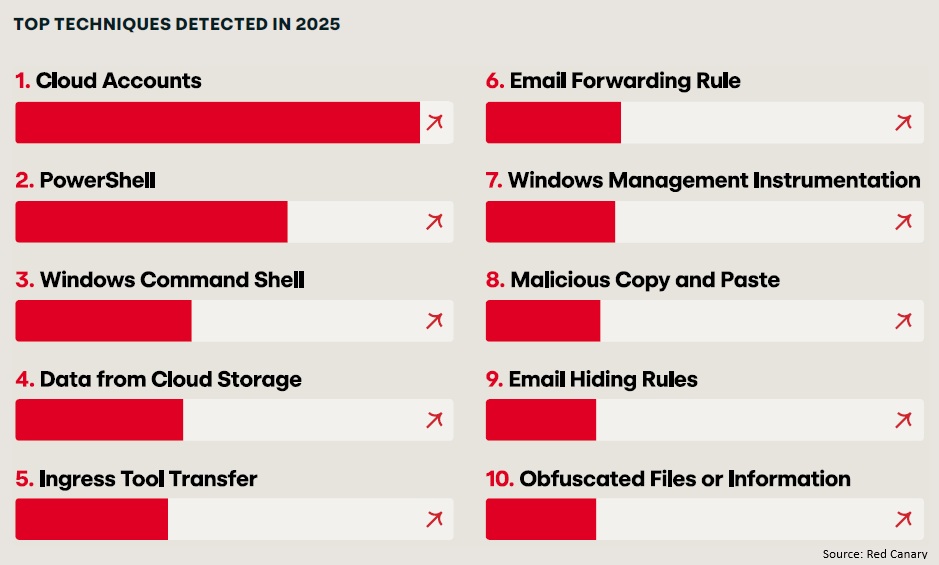
Cloud account abuse was the most prevalent ATT&CK technique detected, which reinforces a simple point: identities are now the gateway to cloud systems, SaaS apps, and corporate AI tools. That makes identity security foundational to both cybersecurity and AI adoption.
The browser is just as critical. Common browser attack paths now include malvertising, SEO poisoning, fake update schemes, paste and run tricks, malicious extensions, credential theft pages, and session token theft. For many organizations, the browser is no longer just a user tool. It is the new frontline environment.
AI risk is also becoming more concrete. Beyond attackers using AI to move faster, enterprises also need to think about malicious AI helpers, compromised AI components, prompt injection, model hijacking, and supply chain attacks on AI tooling. As more organizations deploy AI quickly, these attack vectors become harder to ignore.
The bigger lesson? Strong security fundamentals still matter most: defense in depth, zero trust, least privilege, continuous monitoring, MFA enforcement, conditional access, and tighter control over risky access paths.
Are AI and automation teams in your organization already part of the cybersecurity design conversation?
#Cybersecurity #AI #Automation #IdentitySecurity #ThreatDetection #AIAgents
What are the biggest cybersecurity risks for AI tools, identities, and browsers in 2026?