Key Takeaways
- Agentic AI is pressuring the traditional $300B outsourcing model
- Managed Services are evolving into Agentic Outsourcing
- The new operating model is moving from “people, processes, technology” to “agents, policies, human controls”
The big change in IT services is not just automation.
It is the business model itself.
For decades, outsourcing was built around people, process documentation, SLAs, and lower-cost delivery centers. That model worked when resource availability and labor arbitrage were the key advantages.
But AI changes the equation.
If software agents can execute workflows, monitor exceptions, generate outputs, and improve over time, then the value of a service provider can no longer be measured mainly by headcount.
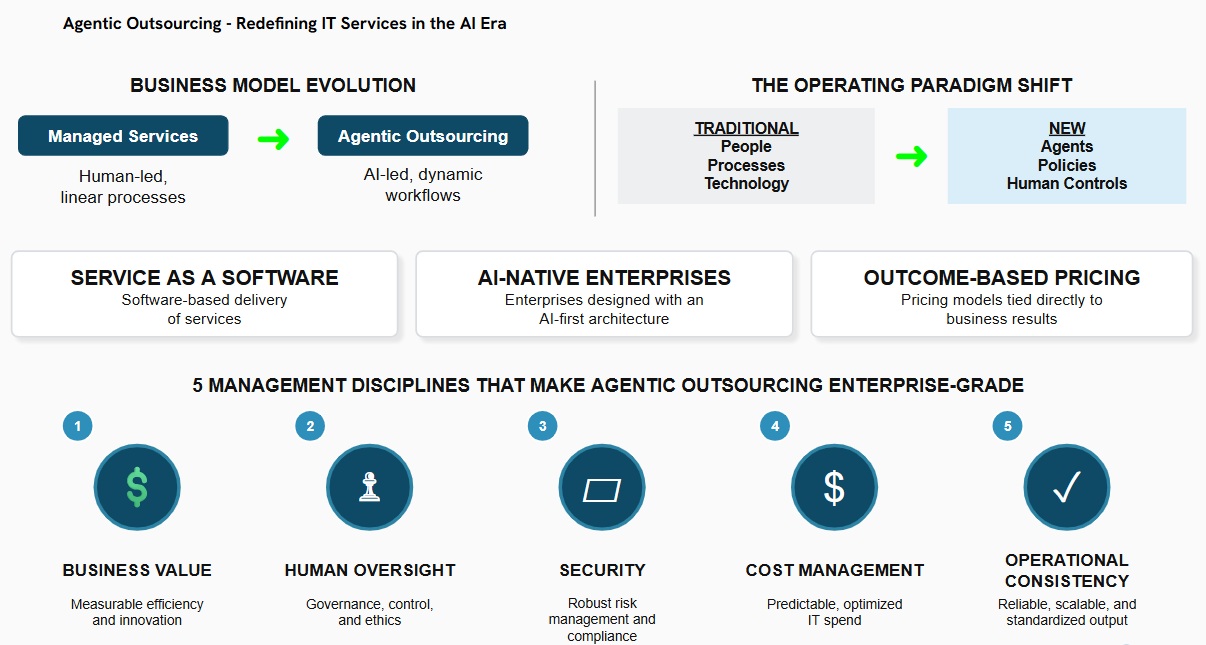
This is where “Service as a Software” becomes important.
Enterprises will increasingly buy outcomes, not effort. They will expect providers to deliver measurable business value, maintain proper human oversight, manage security risk, control AI usage costs, and ensure operational consistency.
That is also why outcome-based pricing will become more relevant.
The question will shift from “How many people are supporting this process?” to “What result are we paying for, and how reliably is it delivered?”
Our view: Agentic Outsourcing will not eliminate IT services firms.
But it will expose enterprises that are still relying on labor arbitrage in a world where intelligence is becoming software-defined.
Are you ready to be transformed into an AI-native enterprise designed with an AI-first architecture?
#AgenticAI #AgenticOutsourcing #ManagedServices #Automation #EnterpriseAI