Key Takeaways
- 77% of CEOs believe AI will shape the future of business, yet two-thirds admit their current business model isn’t ready for autonomy.
- By 2028, one-third of enterprise applications will embed autonomous agents, redefining cost structures, speed, and productivity.
- Agentic AI is not simply smarter automation—it represents a new operating logic where intelligent systems can plan, act, and learn with minimal human oversight.
Deloitte’s Agentic Enterprise 2028 paper positions Agentic AI as the next industrial revolution—a shift as profound as the move from steam to electricity. These intelligent “agents” don’t just execute instructions; they make real-time decisions, orchestrate multi-step workflows, and collaborate with humans to deliver adaptive outcomes across finance, HR, IT, operations, supply chain, and customer experience.
According to the report, agentic capabilities evolve along a six-step autonomy ladder, each stage compounding value and maturity:
1️⃣ Assist – AI supports human operators.
2️⃣ Suggest – AI proposes options and next steps.
3️⃣ Execute – AI completes bounded, end-to-end tasks.
4️⃣ Orchestrate – AI coordinates multi-step workflows with human oversight.
5️⃣ Optimize – AI autonomously enhances performance and efficiency.
6️⃣ Self-Evolve – AI systems learn continuously and optimize themselves.
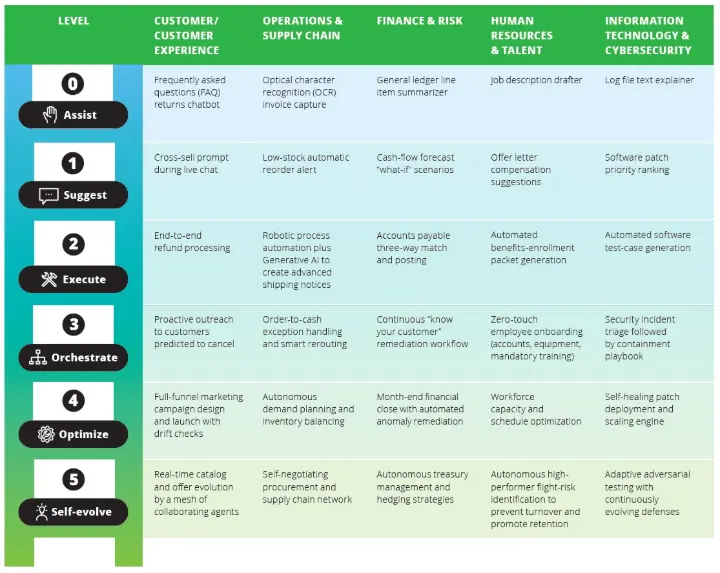
To scale this transformation, Deloitte recommends architecting an autonomous operating system (AOS)—a holistic enterprise blueprint that integrates people, data, and technology through six strategic pillars:
✨ Adaptive strategy – Align autonomy initiatives with business priorities and measurable ROI.
✨ Proactive risk, security, and governance – Build safeguards and “guardian agents” to monitor compliance and ensure responsible autonomy.
✨ Intelligent data ecosystem – Establish a unified, high-quality data foundation for real-time reasoning and decision-making.
✨ Scalable platform and tech enablement – Modernize infrastructure with multi-agent orchestration and agent-to-agent interoperability.
✨ Empowered workforce – Redesign roles and develop new capabilities for human–AI collaboration.
✨ Ongoing change management – Embed adaptability, trust, and continuous learning into the culture.
As Deloitte notes, “Deploying agents alone won’t fix inefficiency; true transformation needs systemic change.”
The rise of the Agentic Enterprise isn’t about replacing people—it’s about re-engineering how organizations think, decide, and operate. Those that start now—investing in clean data, interoperable platforms, human-AI collaboration, and trust—will not only gain early efficiency wins but also build the adaptive, self-optimizing systems that define tomorrow’s industry leaders.
The journey toward autonomy is iterative, but its destination is clear: enterprises that learn, adapt, and evolve on their own.
#AgenticAI #AutonomousEnterprise #FutureOfWork #AIagents #DigitalTransformation #EnterpriseAI #AIArchitecture
What is an “Agentic Enterprise,” and how will it reshape the future of business by 2028?