
Key Takeaways
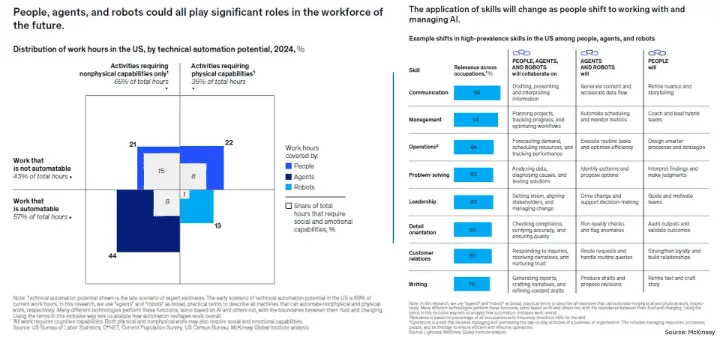
- Today’s technology could theoretically automate 57% of current US work hours, but that does not mean 57% of jobs disappear. Adoption takes time and depends on economics, policy, cost, and how ready organizations really are.
- More than 70% of today’s skills are used in both automatable and non-automatable work, which means most skills are not vanishing. They are being repurposed.
- Demand for AI fluency has grown 7x in two years, while the real prize is larger than task automation alone: McKinsey estimates up to $2.9 trillion in annual US economic value by 2030 if organizations redesign workflows and prepare their people well.
What stood out in the report ‘Agents, robots, and us: Skill partnerships in the age of AI’ by McKinsey is this:
The most exposed work is not necessarily the least valuable work. It is often the most routine version of knowledge work. Basic research, routine writing, accounting, and some coding are becoming easier to automate. But framing the problem, applying judgment, and interpreting results become even more important.
That is the shift many teams still underestimate.
AI strategy should not start with “what tasks can we remove?” It should start with “what workflow can we redesign so humans and machines each do what they do best?”
The leaders who get this right will not just deploy AI. They will build trust, raise AI fluency, and strengthen the human skills that machines still cannot replace easily.
How is your team thinking about this right now: task automation, or true workflow redesign?
#AI #Automation #FutureOfWork #AIAgents #WorkforceTransformation