Key Takeaways
- Most AI agent initiatives stall because they are not embedded deeply enough into real workflows, so humans end up acting as the bridge between insight and execution.
- This agentic action gap can be measured through three things: friction, time to action, and adoption and compliance.
- The winners are not adding more “AI.” They are redesigning work so agents can actually trigger, coordinate, and complete actions inside the business.
AI agents do not create value when they generate answers. They create value when they get real work done.
That is the part many teams still miss.
A lot of companies are busy launching pilots, demos, and internal experiments. But if employees still have to copy, check, route, chase, and manually execute the next step, the agent is not really changing the ergonomics and economics of the process.
That is why Forrester’s framing of the value gap is useful:
🔹 Friction: how much manual effort is still needed
🔹 Time to action: how long it takes for insight to become execution
🔹 Adoption/compliance: whether people actually trust, use, and follow the agent in the real workflow
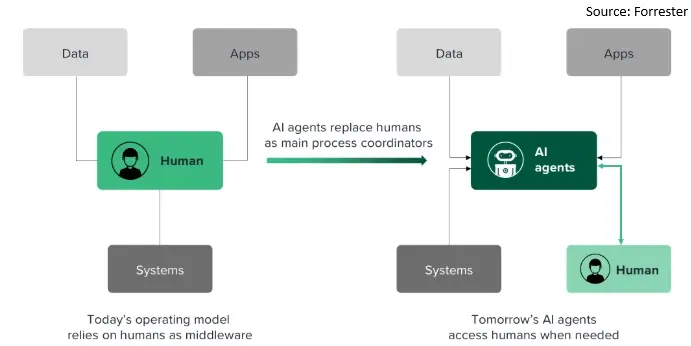
The problem is not “Do we have an agent?” The better question is: can we re-engineer our entire operating model around AI so that the agents are embedded seamlessly inside our business workflows?
Our takeaway: the next phase of enterprise AI will not be won by the smartest or most capable model. It will be won by the teams that connect intelligence to execution.
Where do you think most companies are today: experimenting, stuck in pilot mode, or orchestrating real agentic workflows?
#AIAgents #AgenticAI #Automation #DigitalTransformation #FutureOfWork