Key Takeaways
- AI Engagement is about confidence and mindset. Included and engaged employees were 58% more likely to feel confident innovating with AI.
- AI Activation is about daily use. Salesforce says 100% of their employees are using agents, with 500K+ hours saved and 84% of queries responded to by Employee Agent.
- AI Expertise is about building the human, business, and agent skills needed to work well with AI at scale.
According to Salesforce’s AI Fluency Playbook, merely subscribing to AI tools or sending employees for upskilling courses is not going to cut it. The real bottleneck in AI adoption is change management. And it helps to think of AI fluency as a progression.
First, engagement. People need to believe AI is relevant to their work and feel safe experimenting with it.
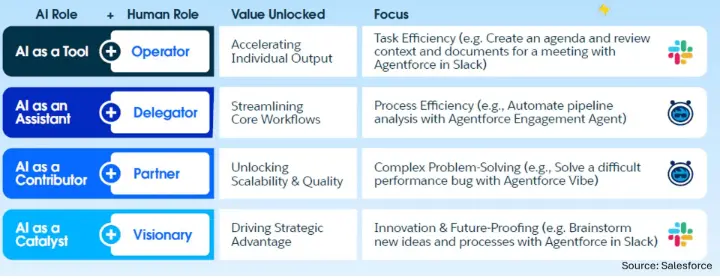
Then, activation. This is where AI moves from “interesting” to “useful.” Not occasional prompting, but embedded habits inside real workflows. The playbook’s Human-AI Collaboration Model makes this practical by showing when AI acts as a tool, assistant, contributor, or catalyst.
Finally, expertise. This is where teams build stronger judgment: adaptability, problem solving, prompt quality, output validation, and workflow orchestration.
Our takeaway for AI and automation leaders: Stop asking, “Do we have AI?” And start asking, “Do our people know how to work with it well, every day?”
That is where the real productivity gains begin.
What do you think is the hardest part of building AI fluency in an organization: mindset, habits, or skills?
#AIFluency #AIAgents #FutureOfWork #Automation #DigitalTransformation
How do you promote real AI adoption in a company?