Key Takeaways
- AI value is shifting from productivity gains to new business models
- The real bottleneck is often knowledge access, not model capability
- Adoption works best as a flywheel, not a one-time rollout
McKinsey interviewed leaders from 15 AI-centric companies and found something striking.
Different industries. Different company sizes. Different stages of maturity.
But the same pattern kept showing up.
AI-native companies are not asking, “How many hours can we save?”
They are asking, “What can we now attempt that was not possible before?”
That is a very different management question.
One concrete example stood out: a Series A marketplace moved from managing 50 deals per adviser to 3,000 simultaneously by using agent analysts for volume work while humans focused on high-trust conversations.
That is not simple automation.
That is operating model redesign.
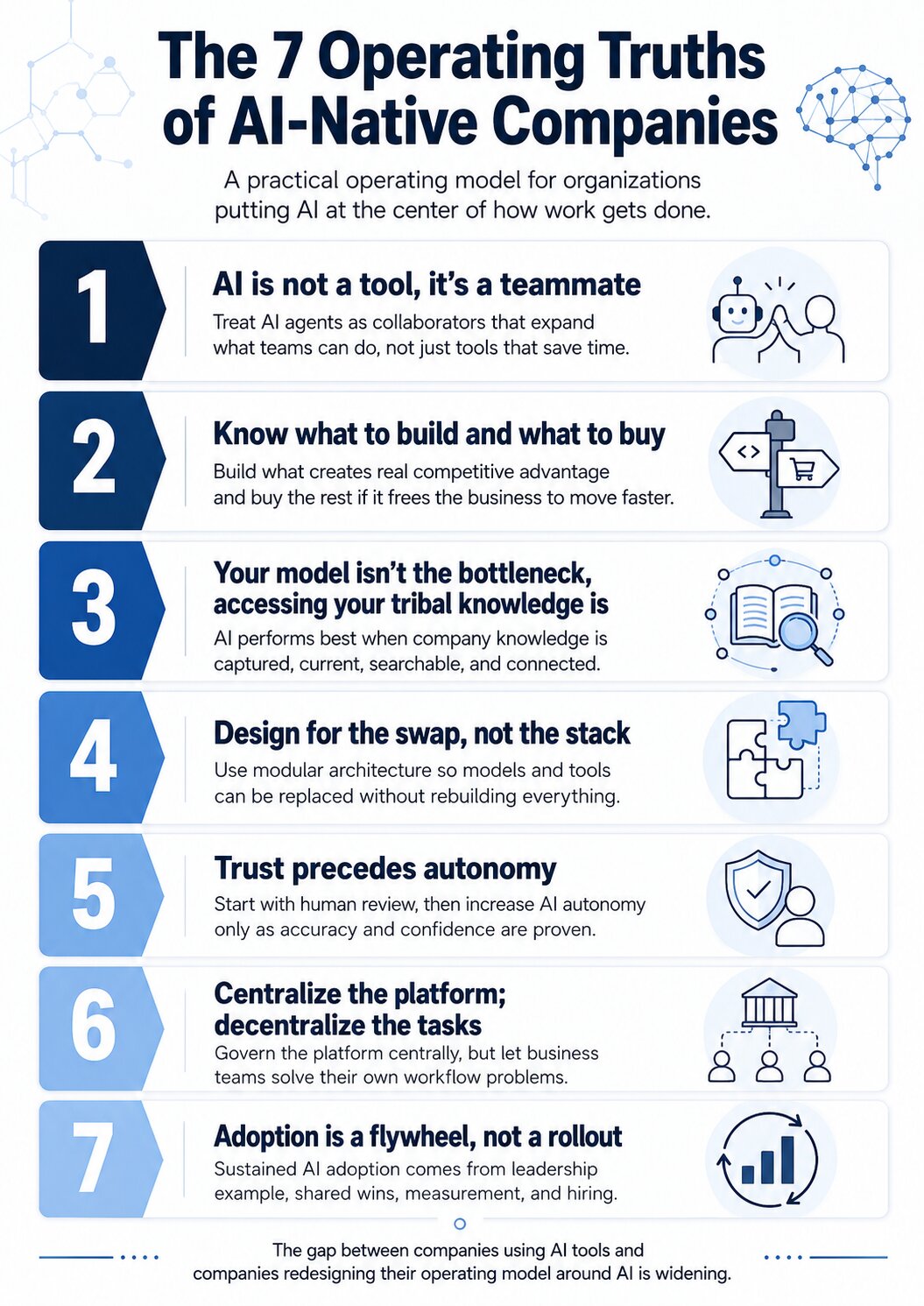
The practical lesson for AI and automation leaders is clear: tools alone will not create transformation.
You need the knowledge layer, the governance layer, the role design, the adoption rhythm, and the trust model.
💡 AI agents need access to the right context.
💡 Humans need clear escalation paths.
💡 Business teams need room to build.
💡 Leaders need to visibly use the tools themselves.
The companies pulling ahead are not necessarily using AI because it is exciting.
They are leveraging unlimited intelligence to expand the art of the possible.
That may be the real strategic shift.
AI adoption is no longer just an IT rollout. It is becoming a test of how quickly an organization can learn, redesign work, and scale trust.
What other companies have you seen using AI successfully to rethink how work gets done and, in the process, radically transform their business model?
#AI #Automation #AgenticAI #DigitalTransformation #BusinessOperations