Key Takeaways
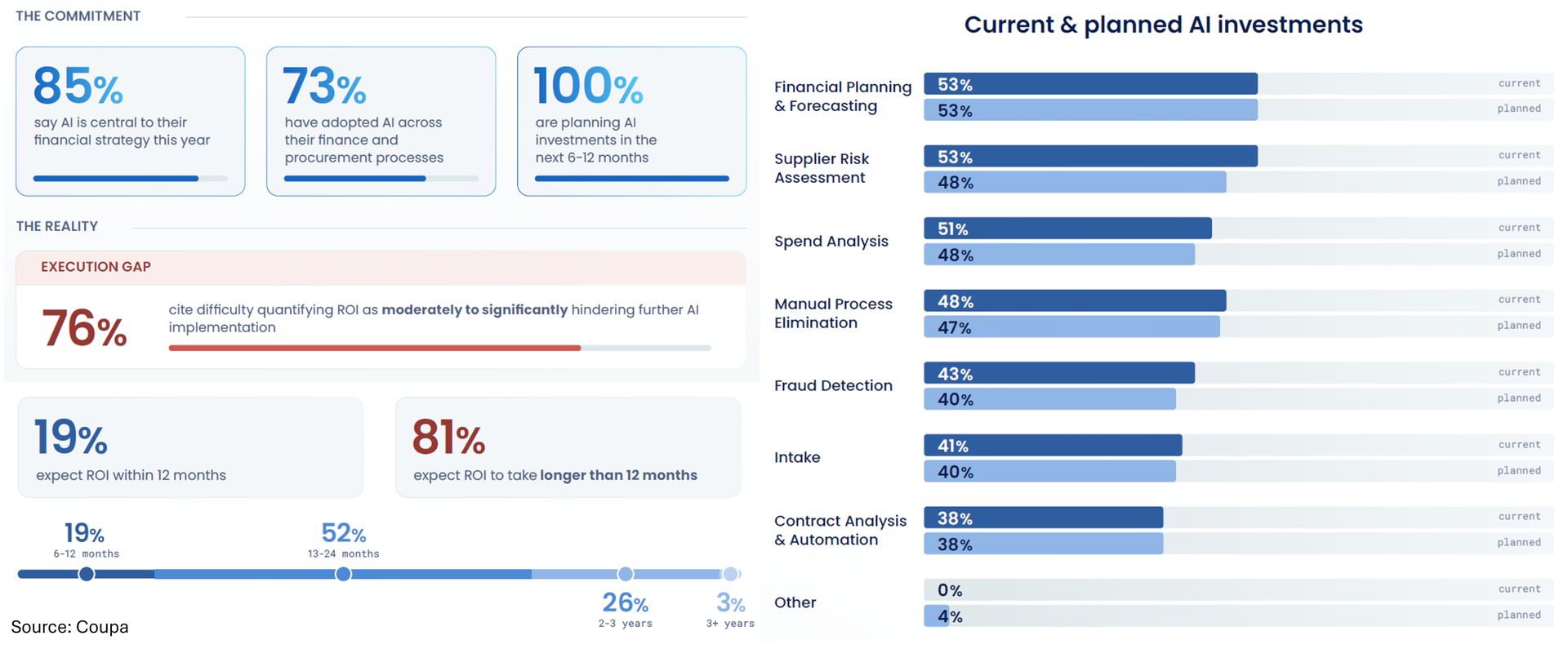
- Every finance leader surveyed are planning AI investments in the next 6 to 12 months, yet 76% say difficulty quantifying ROI is materially slowing further AI implementation.
- 81% expect AI ROI to take longer than 12 months, but that changes dramatically with data access: 76% of CFOs with instant spend data expect ROI within a year, versus just 24% without it.
- Agentic AI may be the biggest opportunity ahead, but most firms are not ready: 49% lack full spend visibility, only 5% can access all spend data in a single system, and 65% cite integration difficulty as a top AI roadblock.
According to The Strategic CFO Report: Global Insights into the AI Inflection Point & How To Stay Competitive, CFOs are no longer just financial stewards. They are increasingly responsible for technology, security, risk, transformation, and growth all at once. 62% oversee technology and security functions, and 90% are concerned about meeting end of year financial goals.
It is not hard to see why AI has moved so high up the agenda. Finance leaders increasingly see it as a way to improve both profitability and growth. 60% are increasing AI investments to drive profitability, 58% to drive growth, while 57% are also tightening spending controls.
What is interesting is that leading finance teams are not treating cost control and growth as opposites. They are using AI to reallocate capital away from low value spend and toward higher return opportunities, faster and with more precision.
Yet many organizations still lack the operating foundation needed to execute on AI. Fragmented data, legacy systems, and complex third party integrations remain major barriers, with 50% citing complex integrations, 50% citing fragmented data, and 41% pointing to legacy systems as key transformation limits.
This is the part of the AI conversation that deserves more attention. Most organizations are still treating AI as a feature layer they can simply add on top of broken processes. But AI does not fix fragmentation. In many cases, it amplifies it.
While early AI gains have come mainly from automation and efficiency, the next wave of value depends on higher complexity use cases such as predictive risk modeling, dynamic capital allocation, and more autonomous decision making. Those outcomes require unified data, integrated workflows, and stronger governance. Governance, in particular, is emerging as a critical gap, with 70% ranking data security and compliance among the top barriers to expanding AI in daily workflows.
That also helps explain why AI adoption is rising while confidence in execution is falling. 92% of finance leaders are concerned about their organization’s ability to implement its AI strategy, up sharply from the prior year.
That is why I this report so fascinating. The headline is not that finance is adopting AI. We already know that. The more important signal is that leaders are discovering the ceiling of AI much faster than expected.
Our takeaway: the winners in AI and automation will not be the companies with the loudest AI story. They will be the ones that quietly build the data infrastructure, workflow integrations, workforce redesign, and governance foundation that makes AI actually useful.
Are most companies underinvesting in AI itself, or underinvesting in the operational plumbing that makes AI work?
#AI #Automation #CFO #AgenticAI #DigitalTransformation #FinanceTransformation
What is stopping CFOs from getting real ROI from AI?